Procure-to-pay · Construction & engineering

Construction doesn't buy like everyone else. Neither does Atlas.

The whole source-to-pay cycle — tender to final payment — plus the three things a general procurement system has no concept of: a statutory prompt-payment clock, lien holdback that is not retention, and bonds held per contract. Built with a construction and engineering firm.

Prompt payment clock & notice window Statutory holdback on every payment Bonds per contract, with expiry alerts Lots & subcontractors
Why a general P2P tool falls short

Three things every other system leaves you to track by hand.

None of these are how a general buyer purchases, so no general procurement product carries them. A construction buyer ends up back in spreadsheets exactly where the money and the legal risk are highest.

Payment is a legal duty, not a preference

A proper invoice starts a statutory clock. Pay late and interest runs; miss the notice-of-non-payment window and the right to withhold is gone on the merits. A general AP process has no concept of either.

Holdback is not retention

Retention is a commercial term you agreed and can vary. Holdback is imposed by statute, held on every payment and released after the lien period. Treat one as the other and you misstate what is owed, and when.

A bond belongs to the job, not the vendor

"A performance bond for half of this contract, from this surety, expiring on this date" cannot be a certificate filed against a supplier. An expired bond on a live site is an uninsured site.

Prompt payment

A proper invoice starts a clock. Atlas is watching it.

Under Ontario's Construction Act, and the equivalent regimes elsewhere, a proper invoice sets the date the owner must pay by, and a shorter window to serve a notice of non-payment. Atlas tracks both against your regime.

  • The payment due date and the notice window, computed from your confirmed regime — not a generic default
  • A regime with no prompt-payment statute is a real answer too — the contract's own terms govern, and Atlas says so rather than inventing a clock
  • Atlas states no legal date it was not given the figures for. The regime ships empty; until an administrator confirms the numbers, the screen asks for them rather than guessing
  • Starting figures ship for every Canadian province and territory, the federal Act and the UAE — a starting point you confirm. Atlas is not giving legal advice, and the screens say so
  • The clock covers the owner tier only. The shorter clocks down the chain, from contractor to subcontractor and beyond, are not computed
.../contracts
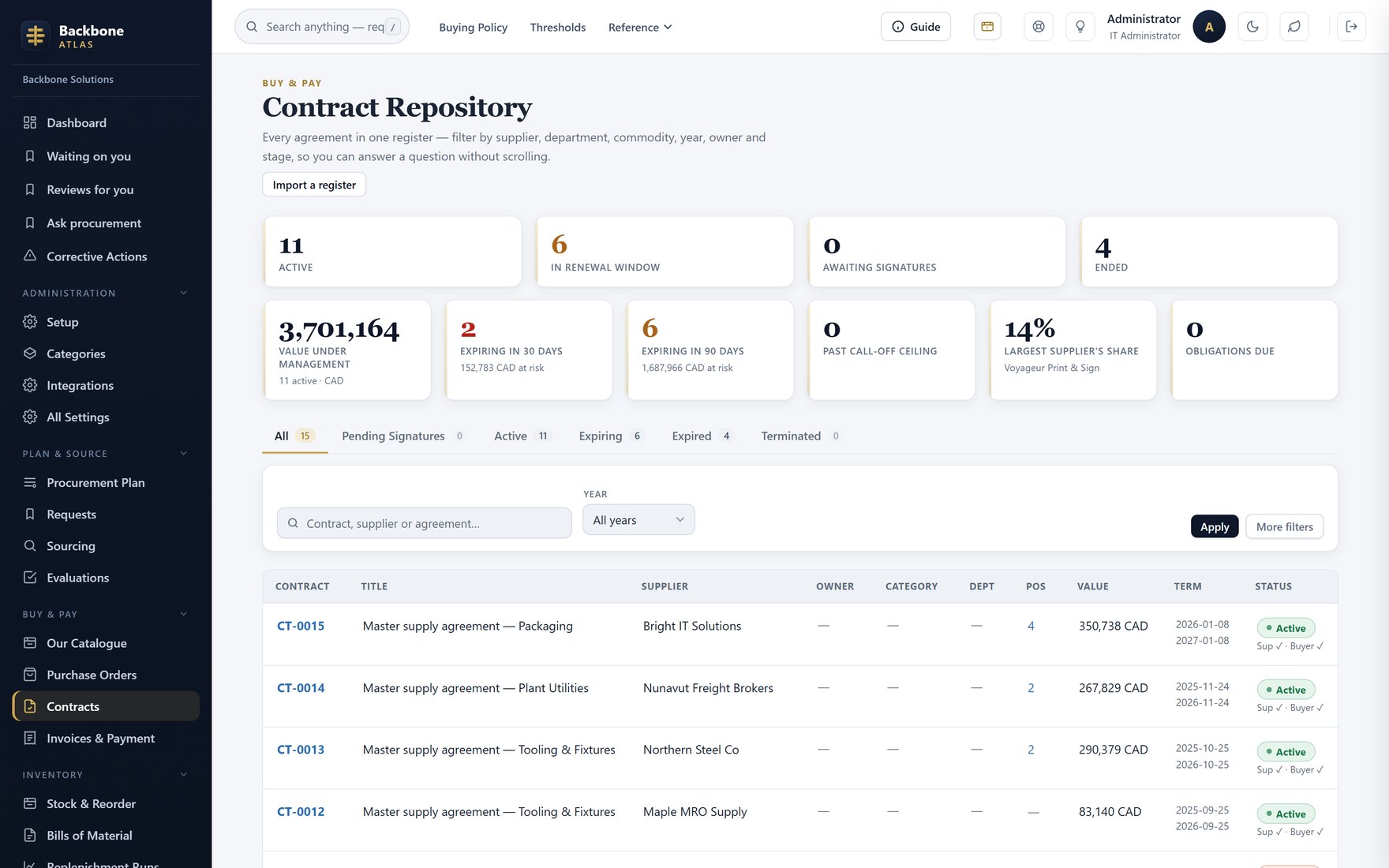
A contract with its milestones, holdback and payment status
ContractPayment clock, notice window, holdback — on one record.
Statutory holdback

Held on every payment. Released when the lien period ends.

Atlas already carried commercial retention on milestones. Holdback is different: a lien protection the statute imposes, held from every payment and released only after the lien period. Atlas holds the two separately, so each payment shows the holdback recorded against it, apart from retention, and when it comes back.

Bonds & guarantees

Every bond, against the contract it protects.

A bond is per contract, with an amount, a surety and an expiry. Atlas holds it that way — not as a certificate filed against a supplier — so cover on a live job is visible and its lapse impossible to miss.

  • Performance, labour & material payment, bid, maintenance and parent-company guarantees
  • Each with its amount, surety and expiry date, tied to the specific contract
  • Warned on the contract before a bond lapses — 45 days ahead — because an expired bond on a live site is an uninsured site
  • In the Gulf edition, on-demand bank guarantees and decennial liability are reflected in the templates
  • The UAE has no prompt-payment clock and no holdback, so Atlas computes neither there. No statute is carried for the US, the UK, the EU or Australia; you enter your own figures
.../suppliers
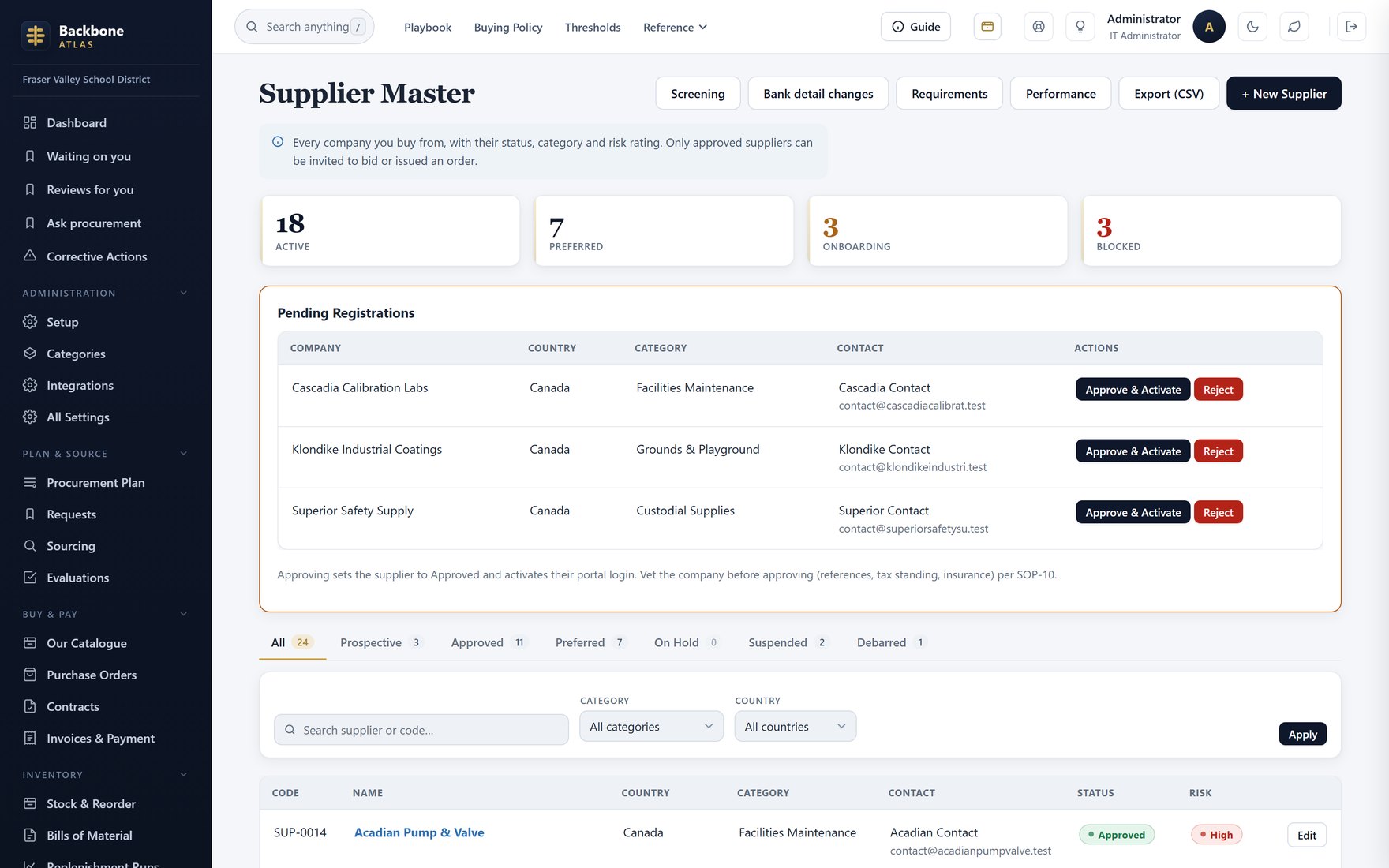
Supplier and contract record showing bonds with amounts and expiry
Cover, in viewBond kind, amount, surety and expiry — per job.
Tendering the way the trades are packaged

Multiple lots, awarded where each is keenest.

A construction tender is rarely one line. Atlas runs a single sealed event split into lots — trades, packages or phases — evaluated by a committee and awarded lot by lot, subcontractors named against the event.

Progress payments

Certify the work, then pay against it.

Construction is paid in stages. Atlas carries the milestone schedule on the contract: each milestone achieved, certified, then invoiced — matched three ways before money moves, with retention on the milestone and holdback recorded against each payment.

  • Milestone schedule on the contract — achieve, certify, invoice, in that order
  • Three-way match on the milestone before payment, the same control as any other spend
  • Statutory holdback calculated and recorded when each invoice is paid, shown apart from retention — never deducted automatically
  • Coded bills post to all eleven finance systems Atlas connects; journal entries to six — QuickBooks Online, Xero, Business Central, Sage Accounting, Sage Intacct and NetSuite
.../contracts
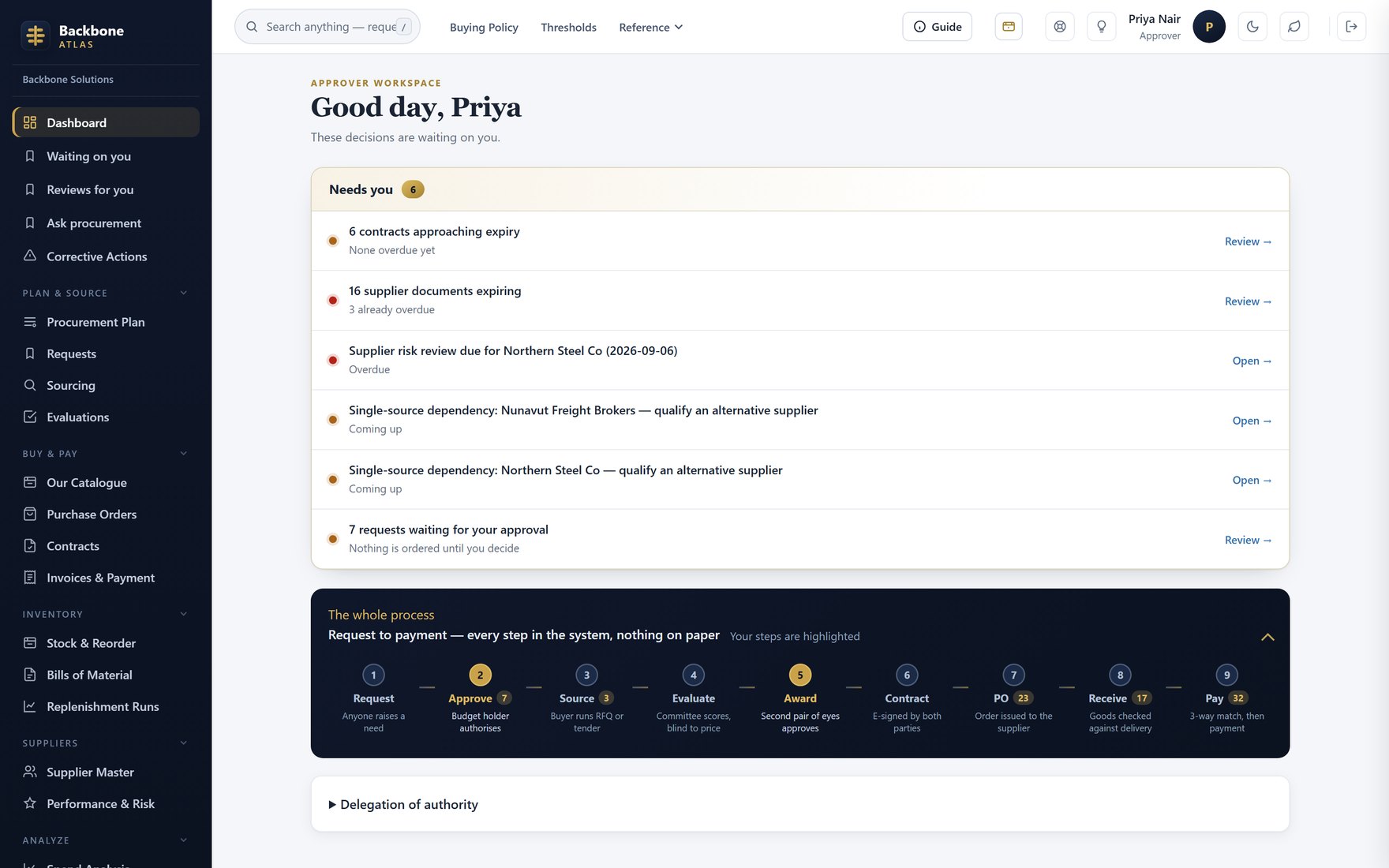
Milestone payment application with certification and match status
Certified, then paidNothing moves until the milestone is signed off and matched.
When it stops you

What this pack refuses, and what to do about it.

Atlas refuses a lot here, on purpose, and every refusal carries its reason on the screen. These are the ones this industry meets, in the words the screen actually uses — so that meeting one is a thirty-second fix rather than a support call.

What Atlas will not do
What the screen says
What to do
A legal date it was not given the figures for
The prompt-payment regime ships EMPTY. Until an administrator confirms your jurisdiction's figures, the screen asks for them rather than computing a date from a plausible default.
Confirm the regime in Settings. A jurisdiction with no prompt-payment statute is a real answer too — the contract's own terms then govern, and Atlas says so rather than inventing a clock.
Two lots sharing a code
Refused as you enter it. An award recorded against the wrong package is the error nobody catches until it is expensive.
Give each package its own code.
Adding a lot after bidders have priced it
Lots can be added only while the event is being planned or quoted. After that no lot is added, so nobody is evaluated against a tender they did not price.
Settle the packages before you invite. A late package means a re-tender, which is what it would be in any case.
An award that puts one firm over the concentration cap
Refused at the moment of award, and the message does not stop at refusing: it names the lots that firm has already won.
Award it elsewhere, or raise the cap deliberately. Splitting a job to spread risk and then letting one firm win it all is a position you should arrive at on purpose.
Work stopped because a bond is missing
Atlas does NOT do this. It warns when a bond is missing, expired on a live job, near expiry, or short against a contract value that variations have grown — and it does not block the work.
Obtain or update the bond and record it. The warning is yours to act on; Atlas will not stop a site on its own authority.
Releasing holdback because Atlas said so
It will not say so. The lien period turns on facts Atlas does not hold. The release prompt is a reminder to check, never authority to release.
Take the decision on your adviser's word. Atlas models the owner tier only; the clocks further down the chain to subcontractors are shorter and it does not compute them.

Every one of these is also written into the guidance drawer on the screen it happens on, and into the process guides your own workspace generates — so a person who meets it at four o’clock on a Friday does not need us, or you.

Said plainly

We compute no legal date we were not given the figures for.

Payment clocks, notice windows and holdback release are only as right as the regime behind them, so Atlas refuses to invent one. Until your administrator confirms the numbers, the screens ask for them; the figures we ship for each province and territory, the federal Act and the UAE are a starting point you verify. A system of record, not legal advice — and it says so on the documents it produces.

See it on your own contracts

Show us a live job. We'll run it end to end.

A short demo on your own regime, your lots and your milestones — tender, award, certify, holdback and final payment, with the clock running.

Book a demo