The whole cycle from request to payment, built for the Gulf. A different regime in every jurisdiction. Decennial (ten-year) liability on construction. Contracts where the Arabic text prevails. Hosted in Canada today. A dedicated in-region instance is possible by separate agreement.
A GCC instance by separate agreementKSA · UAE · Qatar · Oman + jurisdiction switchPublic & private sectorArabic & decennial-liability aware
.../rules
UAE e-invoicing · the buyer's side
Your ASP receives the e-invoice. Atlas takes it from there.
The UAE mandate runs through Accredited Service Providers. Atlas connects to your ASP. It reads each e-invoice, checks it and keeps it. Atlas is not an ASP, and it never reports to the FTA.
Three ways in
Pulled from your connected ASP every five minutes. Pushed to the Atlas API. Or uploaded by hand. Atlas reads PINT AE, and Peppol BIS, UBL and Factur-X.
Checked on arrival
The six FTA document types. The seller’s TRN. That it is not addressed to another company’s TRN. VAT in AED when the invoice is in another currency. A failure is refused, with the reason.
The payment gate
Switch the mandate on from a date. A UAE supplier’s invoice typed into the portal then waits for its e-invoice. Until it arrives, it cannot be approved for payment.
Self-billing
Under a self-billing agreement, Atlas issues the PINT AE self-billed tax invoice. It is marked “Tax Invoice raised by buyer”. The supplier’s own invoice for those supplies is refused.
Invoice responses
Optional. Suppliers hear when their e-invoice is received, queried, rejected, approved and paid.
The archive
Each file is kept as it arrived. A SHA-256 fingerprint is checked every time it is opened. Atlas is hosted in Toronto. UAE guidelines allow storage outside the UAE on three conditions: integrity, retrievability and reproducibility.
No ASP connection has run on a live account yet. Any ASP or ERP can deliver through the Atlas API today. See UAE e-invoicing in full →
Data residency · where your data lives
Your procurement data can stay in the country.
Saudi Arabia’s Personal Data Protection Law allows personal data to leave the Kingdom only with safeguards. Classified government data must be hosted in-country. Most platforms host in one place and cannot answer that. Atlas runs in Canada today. A dedicated instance in your region is possible by separate agreement.
In-region, by agreement
Under a separate agreement, we can set up the entire system in a data centre in your region. Its servers sit in that region. We name every provider involved, including the network edge in front of it.
Named region, in writing
Your instance’s region is set out in the agreement. A residency review gets a one-line answer: it never left the jurisdiction.
Your identity, your sign-on
Connects to your own Microsoft Entra or sign-in provider. Staff use the accounts they already have, under your policies.
When the law says data stays in-country, in-region hosting is the answer. No second system. The same product, set up in your region by separate agreement.
The real settings screen
Honest about the Gulf, not generic.
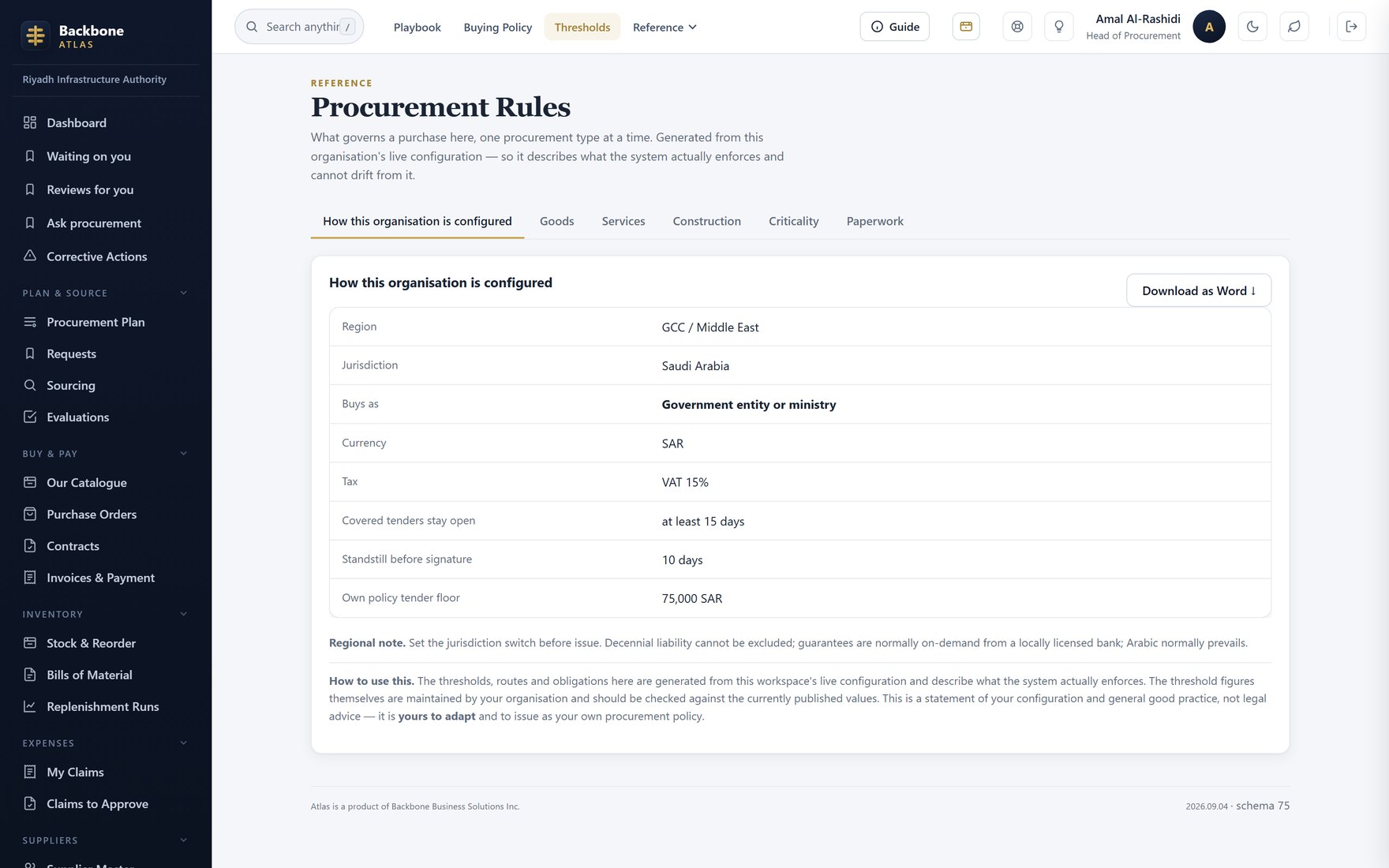
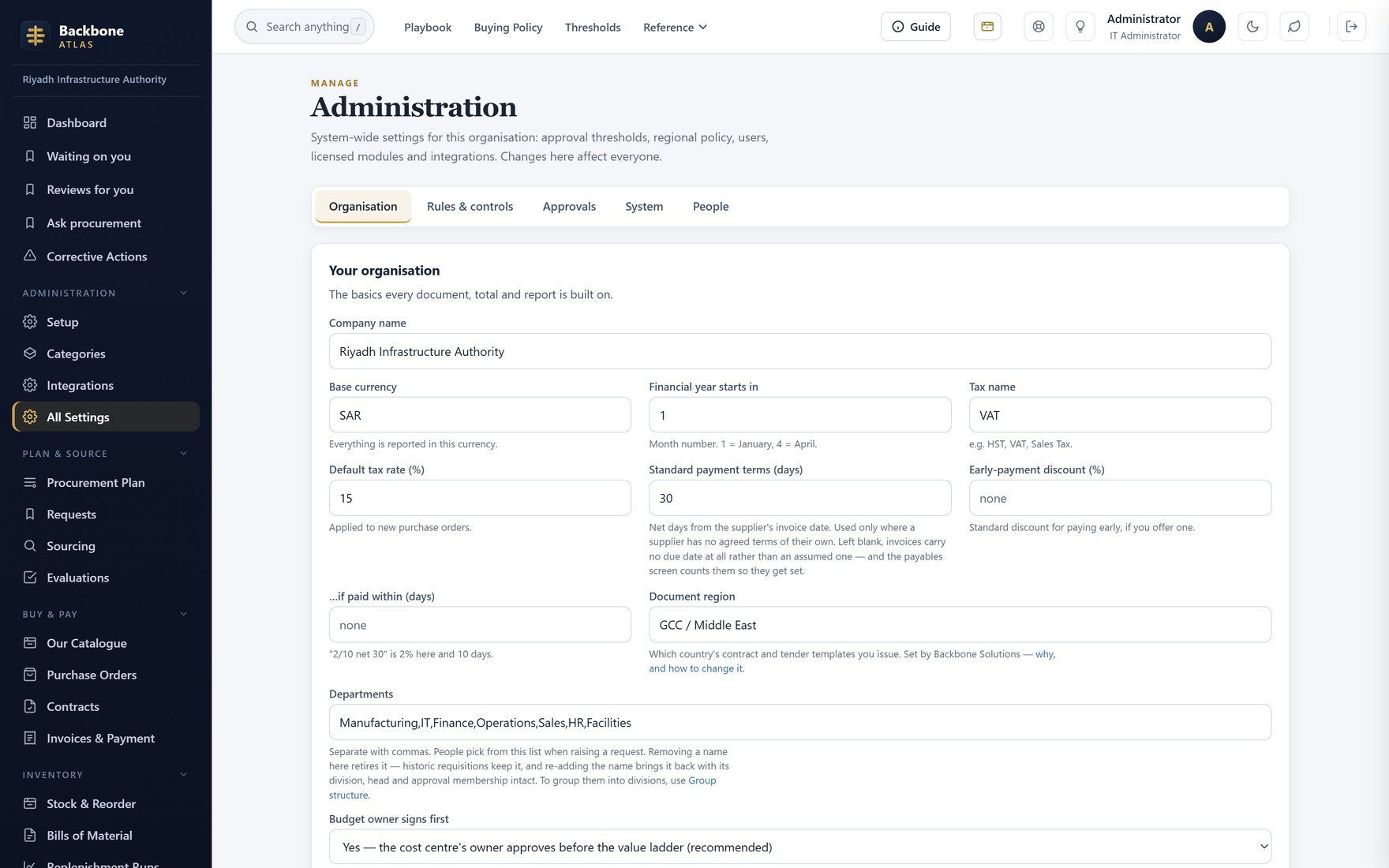
This is the real settings screen. There is no single GCC regime. Each country has its own law, currency and VAT rate: Saudi Arabia, the UAE (federal, Dubai, Abu Dhabi), Qatar, Kuwait, Oman and Bahrain. So the threshold table starts empty on purpose, for your own figures.
No made-up GCC-wide thresholds. The table starts blank for your own jurisdiction’s figures.
Currency defaults to USD and VAT to 5% (UAE, Bahrain, Oman). Saudi Arabia’s 15% is one field away.
Switch jurisdiction or region on this same screen
.../settings
Region ProfileUSD default · VAT 5% · thresholds intentionally blank.
Public sector Ministries · Government entities · State-owned
Tenders that follow each country’s rules.
For government entities, ministries and state-owned enterprises across the Gulf. The rules,
the language and the guarantees change from one country to the next.
Jurisdiction switch for KSA, UAE federal, Dubai, Abu Dhabi, Qatar, Kuwait, Oman and Bahrain. Set before a tender goes out.
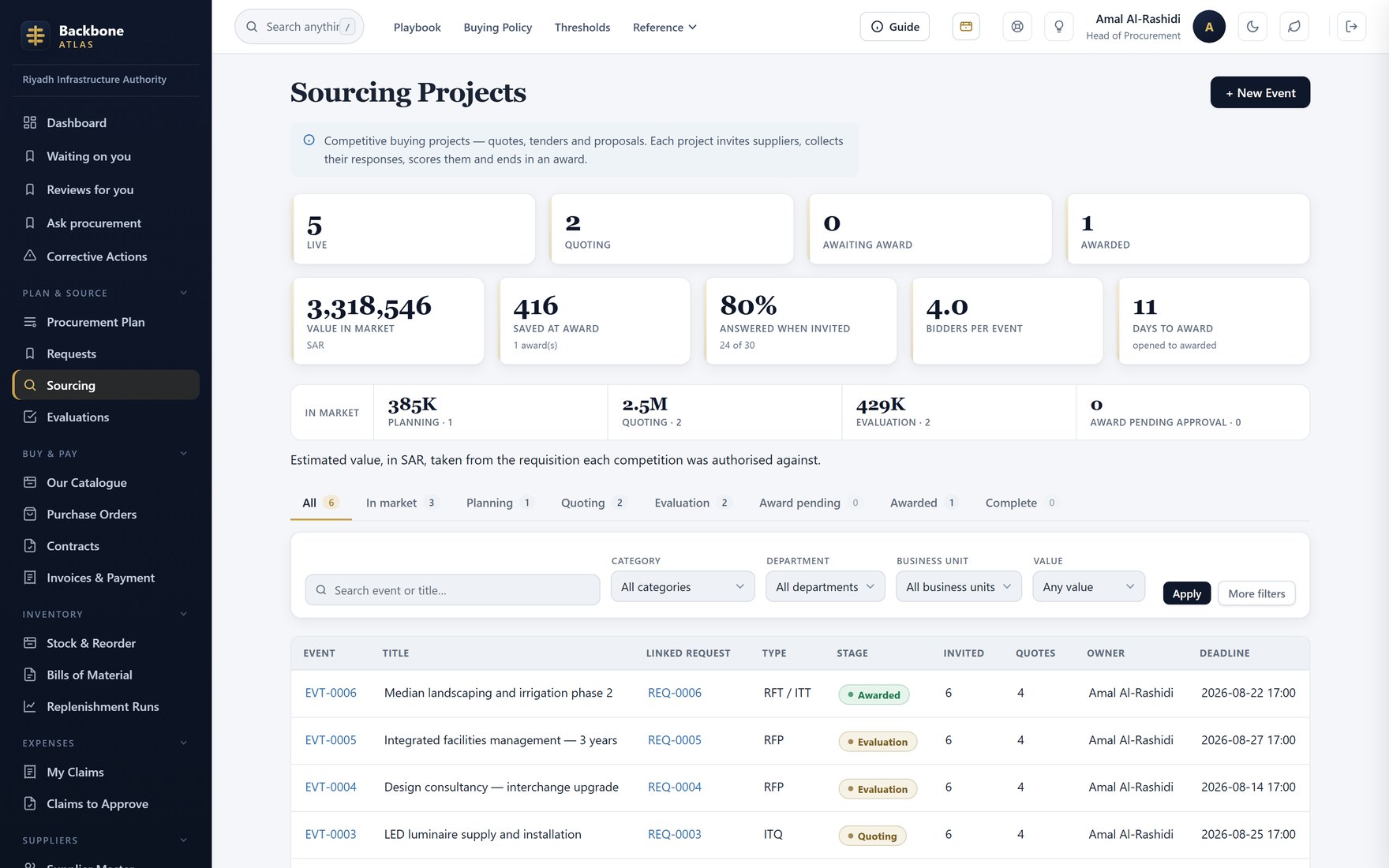
ITT, RFP and construction-tender routes, with the region’s standard documents and response forms
Decennial liability, on-demand bank guarantees and Arabic-prevailing terms in the templates
Sealed bids opened by a named person. Committee evaluation. A complete audit trail.
An ICV (In-Country Value) clause in the Gulf templates, plus local-content scoring criteria. A full ICV report is built on request.
Data must stay in-country? A dedicated in-region instance is possible by separate agreement.
.../sourcing
Sourcing & TenderITT to award, for your jurisdiction.
Private sector Construction · Energy · Conglomerates · Free zones
Spend visibility for a region building fast.
For contractors, energy firms and diversified groups delivering Vision 2030 and the
UAE’s growth agenda. Procurement control at the pace the Gulf moves.
See and cut spend that skips the process. Put it under contract, in AED, USD or any currency you use.
Supplier qualification with ESG and Scope-3 tracking, ahead of Net Zero 2050 reporting
Contracts with milestones, retention and renewal alerts
Connects to eleven accounting systems, including SAP S/4HANA and Oracle Fusion, which most of the Gulf runs on. QuickBooks Online, Xero, Business Central and Sage Accounting are proven on live ledgers. The other seven are built. Each is proven on your own ledger at onboarding. Older SAP ECC pulls a feed.
Live in days to weeks, not a year
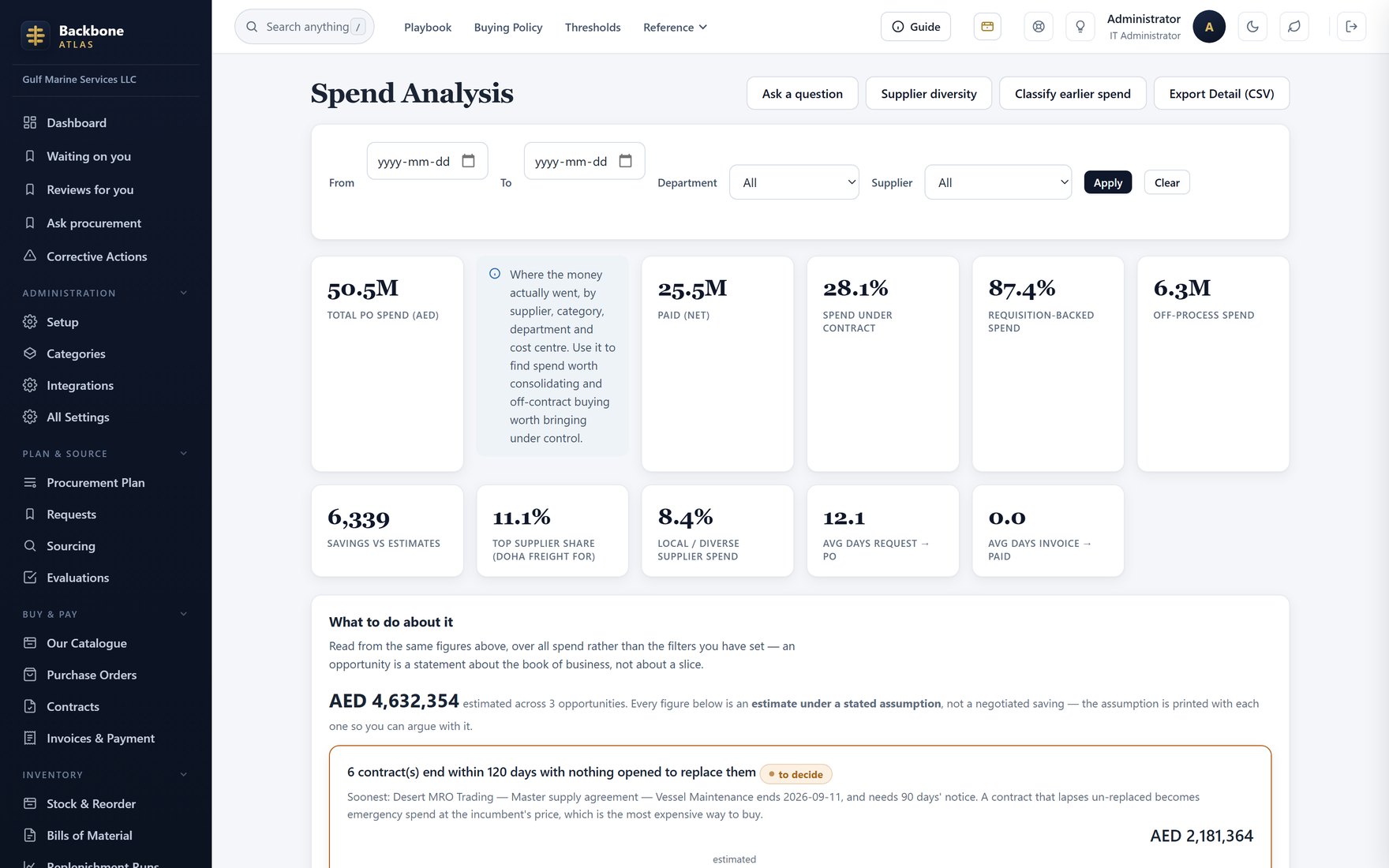
.../spend
Spend AnalysisUnder-contract, off-process and cycle times — in AED.
.../suppliers
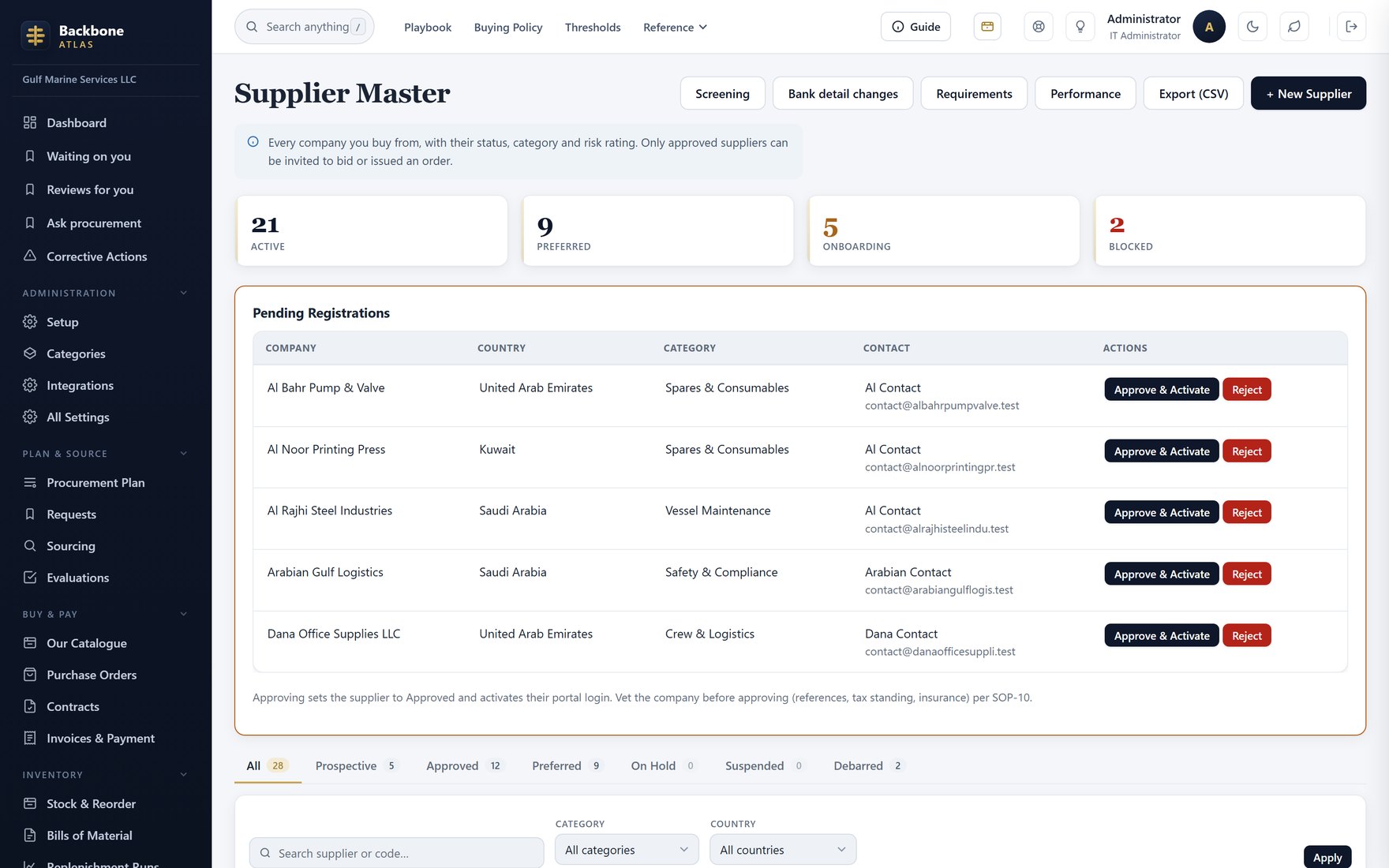
Supplier MasterQualification, risk and local content in one view.
Qualify before you commit
Suppliers qualified, not just registered.
One full record for each supplier: qualification, risk and performance. Plus the local-content
and ESG data the region increasingly reports on.
No awards to suspended, on-hold or debarred suppliers
Certificates and documents chased automatically before they expire
Bank-detail changes are locked down. It is the most abused field in procurement.
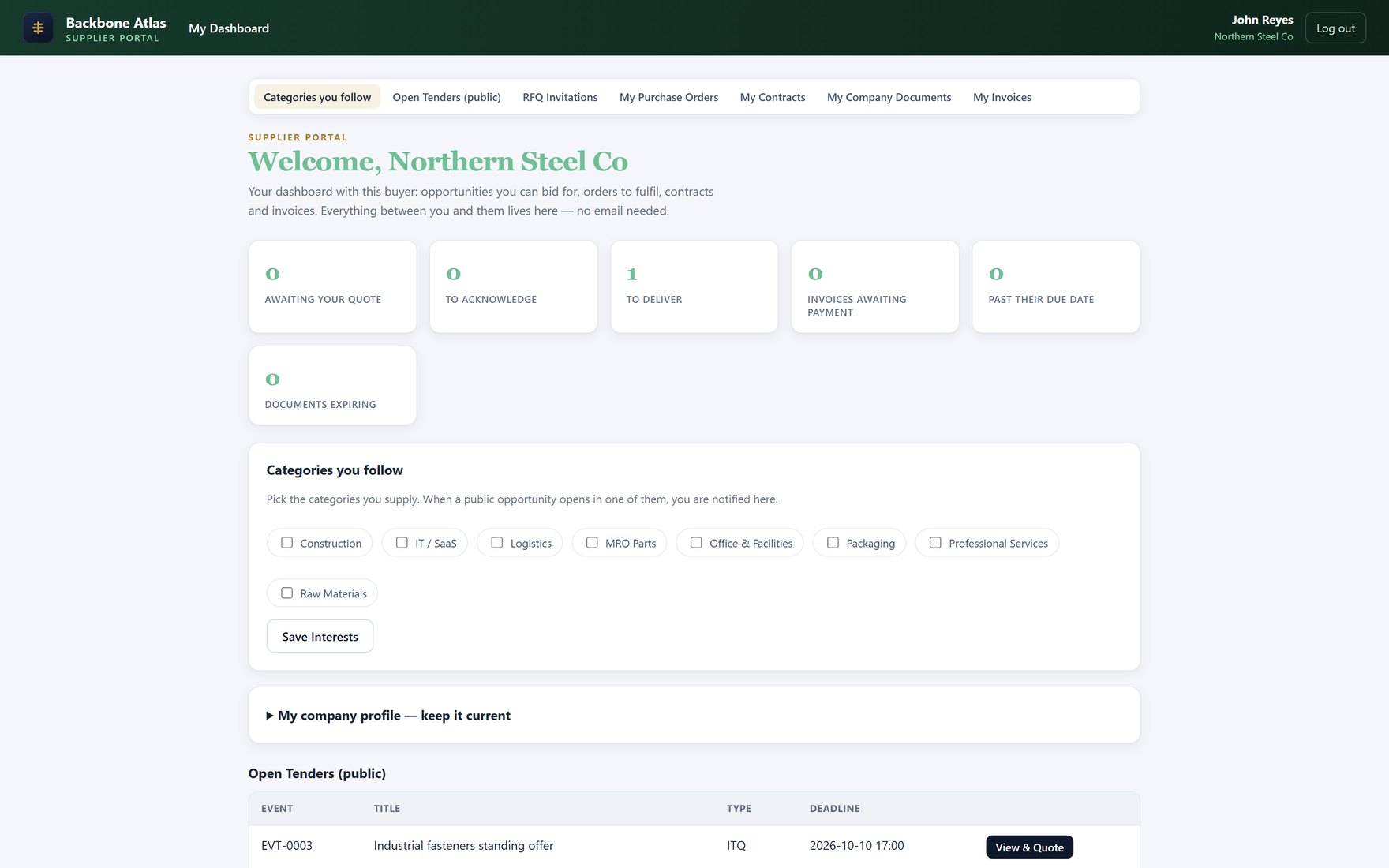
A supplier portal. Suppliers register, quote, get POs, send invoices and get paid. They keep their own documents and bank details up to date.
Local-content and diverse-supplier spend tracked for reporting
The gap it fills
Most tools handed to Gulf teams weren't built for the Gulf.
Imported cloud platforms and generic workflow tools miss what decides a Gulf procurement.
Where the data lives. Which jurisdiction applies. How a tender has to run.
Single-region platforms stall when a PDPL review asks where the data physically sits.
In-country, by agreement. A dedicated instance can be set up in your jurisdiction under a separate agreement. Its servers are there, and every provider is named in that agreement.
Global enterprise suites cost a fortune. In-country hosting is still a separate job, with more cost and delay.
A fraction of the price, in-region once you sign. We set up your in-region instance. No separate hosting project for you to fund or staff.
There is no single GCC regime. Generic tools still treat the region as one.
A jurisdiction switch for KSA, UAE, Dubai, Abu Dhabi, Qatar, Kuwait, Oman and Bahrain. Each has its own forms and rules.
Government tender portals post the RFP. Evaluation, contracts, POs and payment are left to spreadsheets.
Runs the whole cycle. Tender, evaluation, award, contract, PO, invoice and payment, in one flow with a full audit trail.
Imported workflow tools do not know decennial liability, on-demand guarantees or Arabic-prevailing terms.
Built into the Gulf templates. The legal terms are in the paperwork from the start.
Sustainability and local-content reporting get added late, as a separate job.
ESG, Scope-3 and local-content tracking are built in. The Gulf templates carry an ICV clause. A full ICV report is built on request.
Connects to your stack
Works with the systems you already run.
SAP and Oracle dominate Gulf finance. Atlas keeps the procurement record and posts straight to your connected
ledger. An older ERP pulls a read-only feed on its own schedule. Contracts and milestones reach AP with no manual handover.
Coded bills post to all eleven connected ledgers. Purchase orders post to eight, journals to six.
Older ledgers pull read-only feeds as JSON or CSV: purchase orders, invoices, suppliers, contracts and journals
Your ERP pulls the feed on its own schedule. No middleware, no integration project.
One secured API key. Integration stays off until you switch it on.
Your ERP connects over your own approved network route
.../integrations
Integration HubPosts to eleven ledgers; older ERPs pull a feed.
See it on your own procurement
Gulf procurement, in one system.
A short demo on your jurisdiction, categories and sector. The whole cycle, end to end.
An instance in the region you choose is possible by separate agreement.