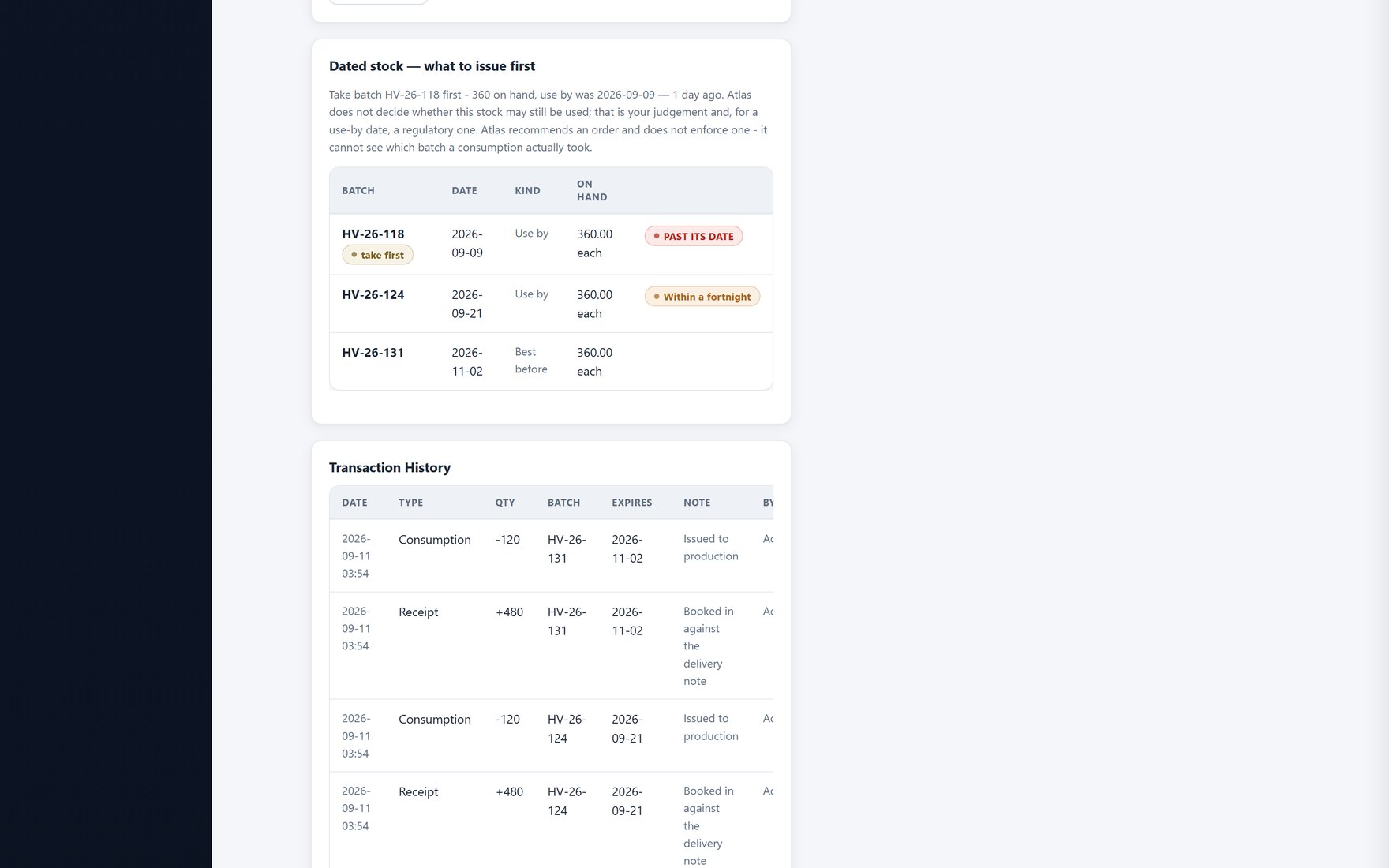
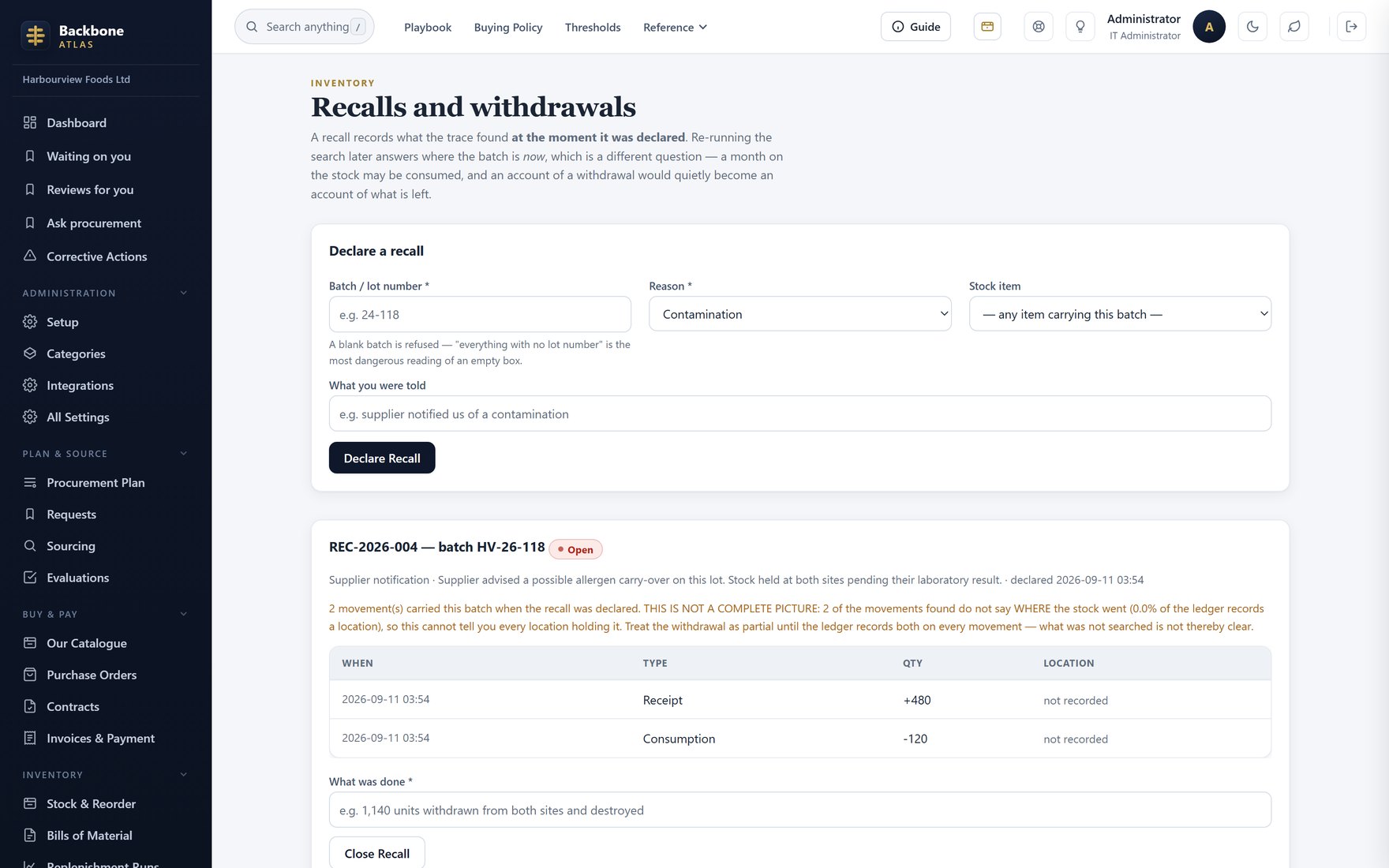
Minimum remaining shelf life measured where goods are booked in, batch traceability through the stock ledger, and a recall or withdrawal recorded as a record — with the trace kept exactly as it stood on the day it was declared.
None of them are subtle once food is involved, and all three are the difference between a record that stands up afterwards and one that quietly says something else.
Certificates expire; so does the product. Atlas already tracked document expiry, and adding a second arithmetic for stock would have given you two answers to one question. Shelf life extends the ladder that existed rather than forking it — on shorter rungs, because sixty days of notice on a twenty-one-day chilled line is not notice.
Re-run a trace a month after a withdrawal and the batch has been consumed and the locations have emptied. The account of what you withdrew becomes an account of what is left, and nothing on the screen says it changed. So the trace is frozen when the recall is declared, and the current position is offered separately and labelled as a different question.
A recall over a ledger where some movements carry no batch, or record no location, has searched the part that could be searched. Atlas carries both gaps into the recall record and will not describe the withdrawal as complete while either stands. What was not searched is not thereby clear.
The date lives on the batch, not on the movement — the same lot is received more than once, and two independently typed dates for one physical fact would decide the issue order while both looked right. Atlas records which kind of date it was told, use-by or best-before, and decides nothing from it.
Declaring a recall takes the trace at that moment and stores it: what was found, who declared it, why, what was done and who closed it. Reopening it shows you what you acted on, not what has happened since.
Tracing a batch to every place it reached, and measuring remaining shelf life against your minimum at receipt, work the same way in all six regions Atlas serves. Two things attached to them do not, and Atlas asserts neither.
Atlas refuses a lot here, on purpose, and every refusal carries its reason on the screen. These are the ones this industry meets, in the words the screen actually uses — so that meeting one is a thirty-second fix rather than a support call.
Every one of these is also written into the guidance drawer on the screen it happens on, and into the process guides your own workspace generates — so a person who meets it at four o’clock on a Friday does not need us, or you.
These are named so you can decide with them in view — one is where a built capability deliberately will not act on its own, and two are judgements Atlas will not make for you.
A short demo on your own products and dates — stock booked in against a shelf-life policy you set, a batch traced to every place it went, and a recall declared, evidenced and closed.
Book a demo