Procure-to-pay · Oil & gas

The spend belongs to the project. Not to the department.

Atlas adds a sanctioned capital budget above the cost centre — an AFE in Calgary or Aberdeen, a concession or PSC budget line in the Gulf — with the ceiling checked cumulatively, and agreed unit rates that survive the award instead of being re-keyed by hand.

Capital cost object above the cost centre Cumulative sanction ceiling Your region's word for it, or none Rates measured, then certified
Why a general P2P tool falls short

Three things a general buying system has no shape for.

Every procurement product codes spend to a cost centre and a general-ledger account. An operator's money is not organised that way, and neither is the work it buys.

A cost centre lives for ever. A project does not.

A well, a tie-in, a turnaround: sanctioned once, spent against by several cost centres, and then closed. There is nothing above a cost centre in a general system, so capital spend is tracked in a spreadsheet beside the one that is meant to control it.

A ceiling tested one purchase at a time is a hurdle

Check a sanctioned amount against each requisition on its own and it refuses one large purchase and waves through six small ones that come to more. Atlas sums what is already committed before it answers, so the sanction cannot be passed by splitting a purchase.

The rates you competed die at the award

A bill of quantities is imported, priced by four bidders, scored line by line and defended on those rates — and then the contract records one number. The agreed rates are re-keyed by hand or lost, and the work is valued from whatever anybody can find.

The capital cost object

A sanctioned piece of work, with its own budget.

It sits beside the cost centre and the account on the screen that already carries them, and every requisition can be coded to it. Spend analysis gains it as a pivot. Nothing else about your buying changes.

  • It ships empty. Until somebody creates one there is no field, no column and no pivot — switching the pack on is an addition, never a migration
  • The ceiling is checked cumulatively, against everything already committed, so it cannot be passed by splitting a purchase
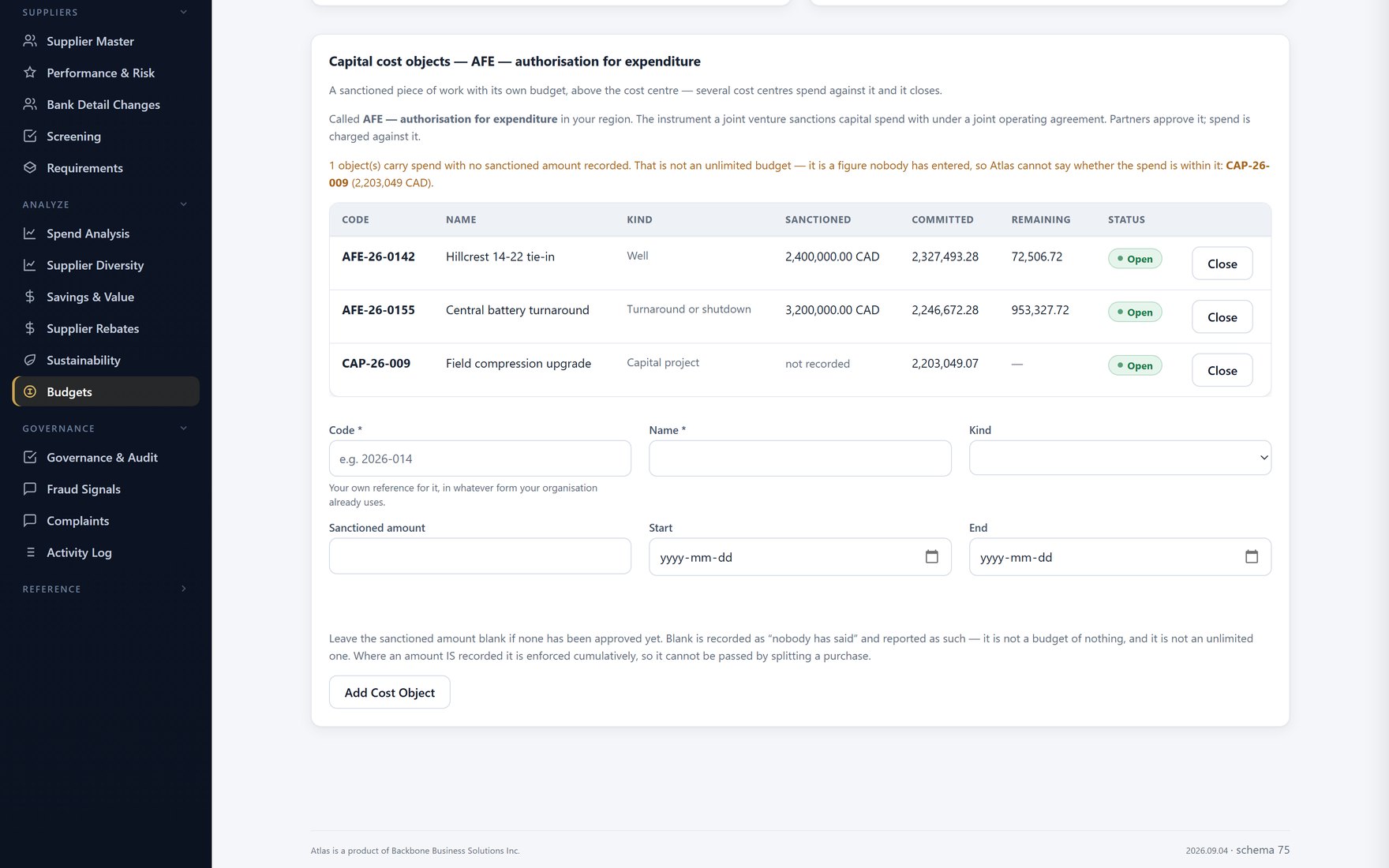
  • No sanctioned amount recorded is not an unlimited one. Atlas names the objects carrying spend against a budget nobody has entered, rather than showing a confident blank
  • A sanction in another currency is refused, not converted — what was approved was an amount, not a rate
  • A closed object refuses new spend and keeps its history, because the question an auditor asks about a capital project is always asked after it has closed
.../budgets
Capital cost objects on the budgets screen: sanctioned, committed and remaining, headed AFE — authorisation for expenditure
A Canadian operatorSanctioned, committed, remaining — beside the cost-centre budgets.
Your region's word for it

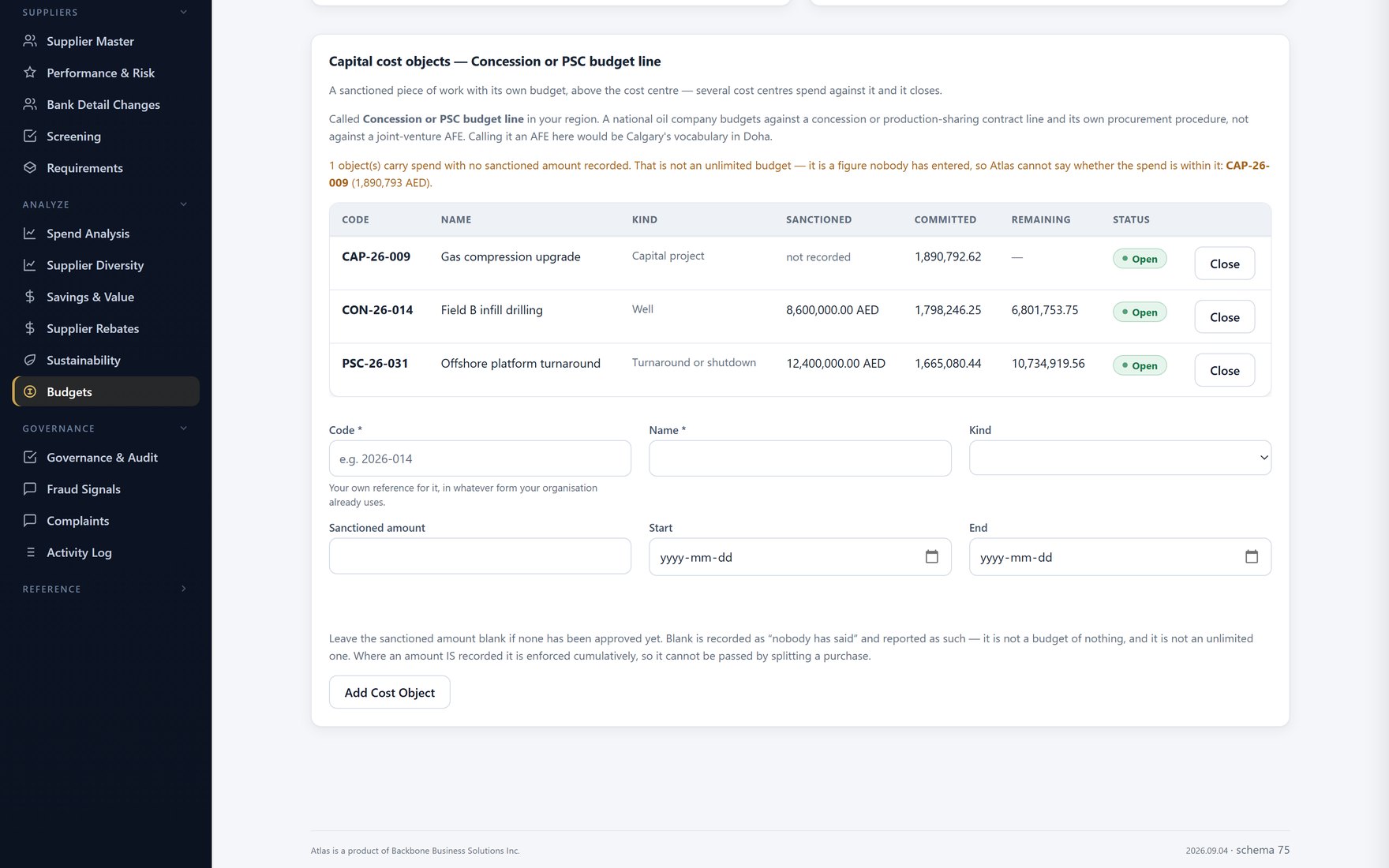
The same screen. A different word, because it is a different instrument.

An AFE is how a joint venture sanctions capital under an operating agreement in North America and the North Sea. A Gulf national oil company budgets against a concession or production-sharing-contract line and its own procurement procedure. The mechanism is common; the word is not, and Atlas will not lend one region's to another.

  • Canada, the United States and the United Kingdom — AFE, authorisation for expenditure
  • The GCC — concession or PSC budget line
  • The European Union and Australia — deliberately blank. Atlas has not established the local term, so the screen names the object neutrally and says so. The nearest plausible word is exactly how one region's practice ships as universal
  • The same rule governs what the rates are called: a unit price schedule in Canada and the US, a schedule of rates in the UK, the EU, the GCC and Australia
.../budgets
The same budgets screen in a Gulf workspace, headed Concession or PSC budget line, with amounts in AED
A Gulf operatorOne screen, two vocabularies — and neither is a translation of the other.
Rates that survive the award

An estimated quantity is not a commitment. A measured one is not an estimate.

Atlas already competed the schedule: the bill of quantities imported, every bidder's rate per line, scored line by line. What was missing was carrying those rates onto the contract, where the work is actually valued. They are carried now, and the value is computed from the rate and the quantity somebody measured on site.

When it stops you

What this pack refuses, and what to do about it.

Atlas refuses a lot here, on purpose, and every refusal carries its reason on the screen. These are the ones this industry meets, in the words the screen actually uses — so that meeting one is a thirty-second fix rather than a support call.

What Atlas will not do
What the screen says
What to do
A capital object with no sanctioned amount
Reported as nobody having said, never as a budget of zero: “That is not an unlimited budget — it is a figure nobody has entered, so Atlas cannot say whether the spend is within it.”
Record the sanction when it is approved. Until then the spend is allowed and the absence is on the screen — you are not blocked on day one.
Three requisitions that each fit
They will not all fit. The ceiling is cumulative, and the refusal shows its working: what is sanctioned, what is already committed, what this would take it to, and how much is left.
Raise a supplementary sanction, or charge it elsewhere. A ceiling checked one purchase at a time is a hurdle, not a ceiling.
Spend in a currency the sanction is not in
Refused, not converted. “A sanctioned amount is an amount in a currency, and what was approved was not a rate.”
Charge it to an object in that currency, or record the sanction in the currency the spend is actually in.
A rate with no unit of measure
The unit is part of the price, and a schedule line that names none is left behind at adoption — with a count, never silently.
State the unit on the rate. Those lines have no agreed rate on the contract until you do, which is the honest position rather than a gap to fill in.
A quantity measured in the wrong unit
Refused, never converted. “Atlas does not convert between units of measure, so it will not value one against the other.”
Record the quantity in the rate's unit, or agree a rate in the unit the work is measured in.
Certifying your own measurement
Refused. “Certification is somebody else confirming a claim — the same authority a goods receipt carries for an order — and it means nothing if it is the claimant's own.”
Somebody else certifies it. A rejected measurement is not certified either: record a new one, because the rejection is part of the history of what was claimed.
A rate of zero carried across from a bid
Refused. “A rate of nothing is how an unpriced line is recorded, not a price of zero.”
Agree a rate before any quantity is valued against the line. Carrying a nil across would publish on a contract that the work is free.
A total across two currencies
No total is shown at all. “A figure summed across two currencies is not a smaller answer, it is a wrong one.”
Correct the rates. Every rate adopted onto a contract carries the contract's own currency, so this can only come from a hand-entered row.

Every one of these is also written into the guidance drawer on the screen it happens on, and into the process guides your own workspace generates — so a person who meets it at four o’clock on a Friday does not need us, or you.

Said plainly

What this pack is not, and why.

Building it established that several things an oil & gas pack is expected to contain either belong somewhere else in Atlas or are blocked on something real. Both are named here rather than left to be discovered.

Not in this pack
What is true today
HSE prequalification — and deliberately so
Atlas already refuses an award when a supplier's required document is missing or lapsed, at every award path, naming the document in the refusal. An HSE requirement is therefore a row an administrator adds, not code. This pack contains no second gate, because the cheapest way for it to become dangerous would be a second gate that disagreed with the first.
Inspection and expediting milestones
Milestones in Atlas are per contract, carry an amount and run a billing ladder. They cannot express a hold point on a long-lead purchase order. That needs a per-order structure and is its own piece of work — not built, and not implied.
Material certification — mill certs and heat numbers at receipt
Batch and heat identification runs through the stock ledger, so a batch can be traced to every place it went. The mill certificate itself is not captured yet — and the mechanism for it now exists: your supplier attaches a document to the delivery note they raise, which is how a certificate of analysis works in the FMCG pack today. What is missing is narrower. A mill certificate is required per item or heat rather than per category, and it carries heat, cast and specification for a buyer to check against the line. Cost, then, not a precondition.
Joint-venture billing — JIBs and cash calls
A cost object is a coding and reporting dimension. Invoicing partners for their share of an operator's spend is a whole accounting function and is not what this is. Nobody should be sold JV accounting on the strength of it.
The cost object does not reach your ledger
Atlas posts bills to eleven finance systems — four proven against live ledgers today, the other seven proven against your own ledger during onboarding — and the posting shape carries one analytic dimension, already filled from the cost centre. Competing with that would change how bills post to ledgers already proven live, so the cost object stays a coding and reporting dimension inside Atlas. That is the honest gap.
See it on your own sanction

Bring one AFE. We'll run the spend against it.

A short demo in your own region's vocabulary and currency — a sanctioned object, requisitions coded to it, the ceiling tested cumulatively, and a schedule of rates measured and certified.

Book a demo