One system from request to payment. USD and sales tax built in. Your own approval ladder. No rules forced on you that do not bind you. Private sector today, public sector when you sign. The process is built. We set up your jurisdiction’s rules before you go live.
USD and sales taxNo per-seat chargesRequisition to paymentA US instance by separate agreement
.../rules
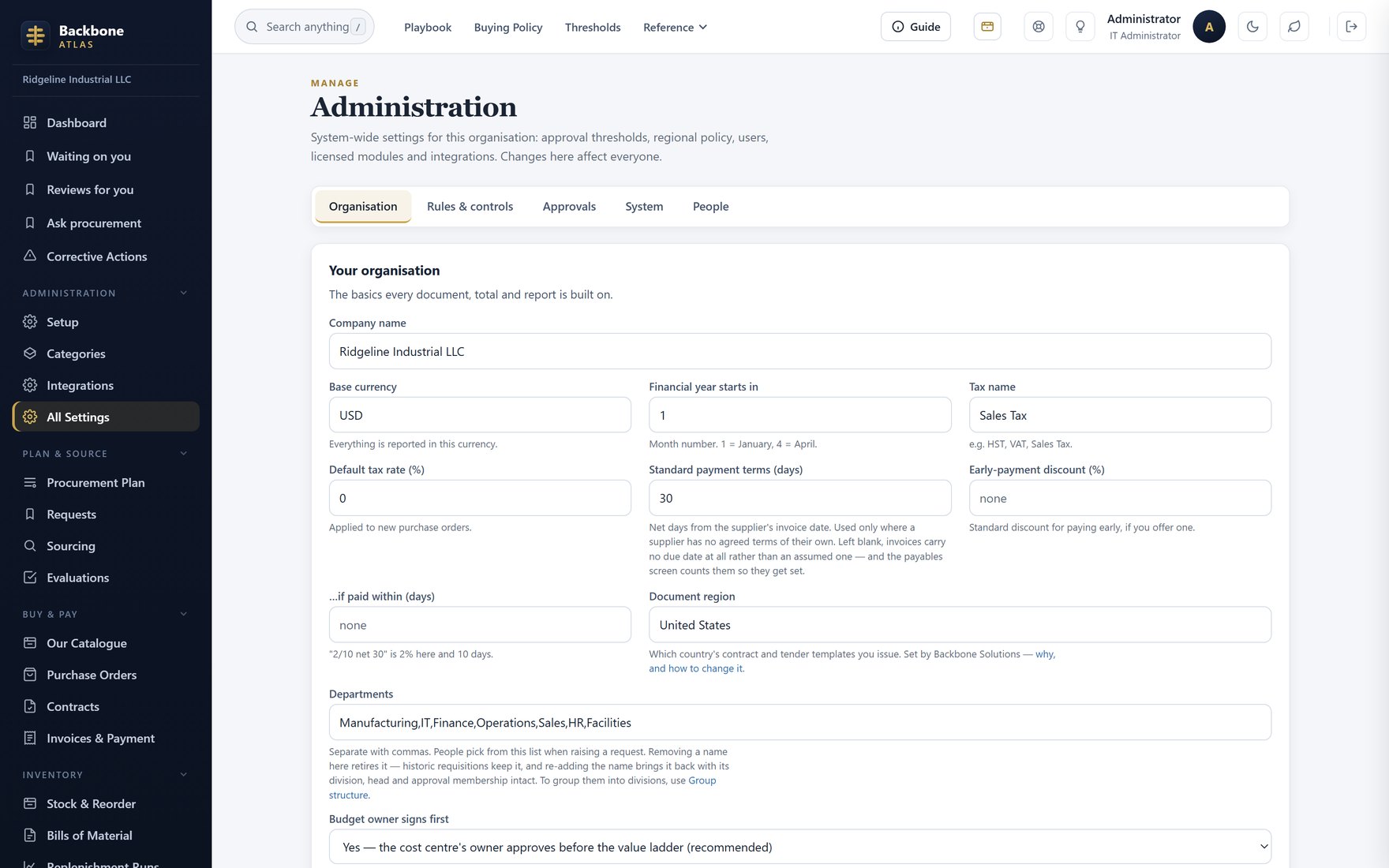
The real settings screen
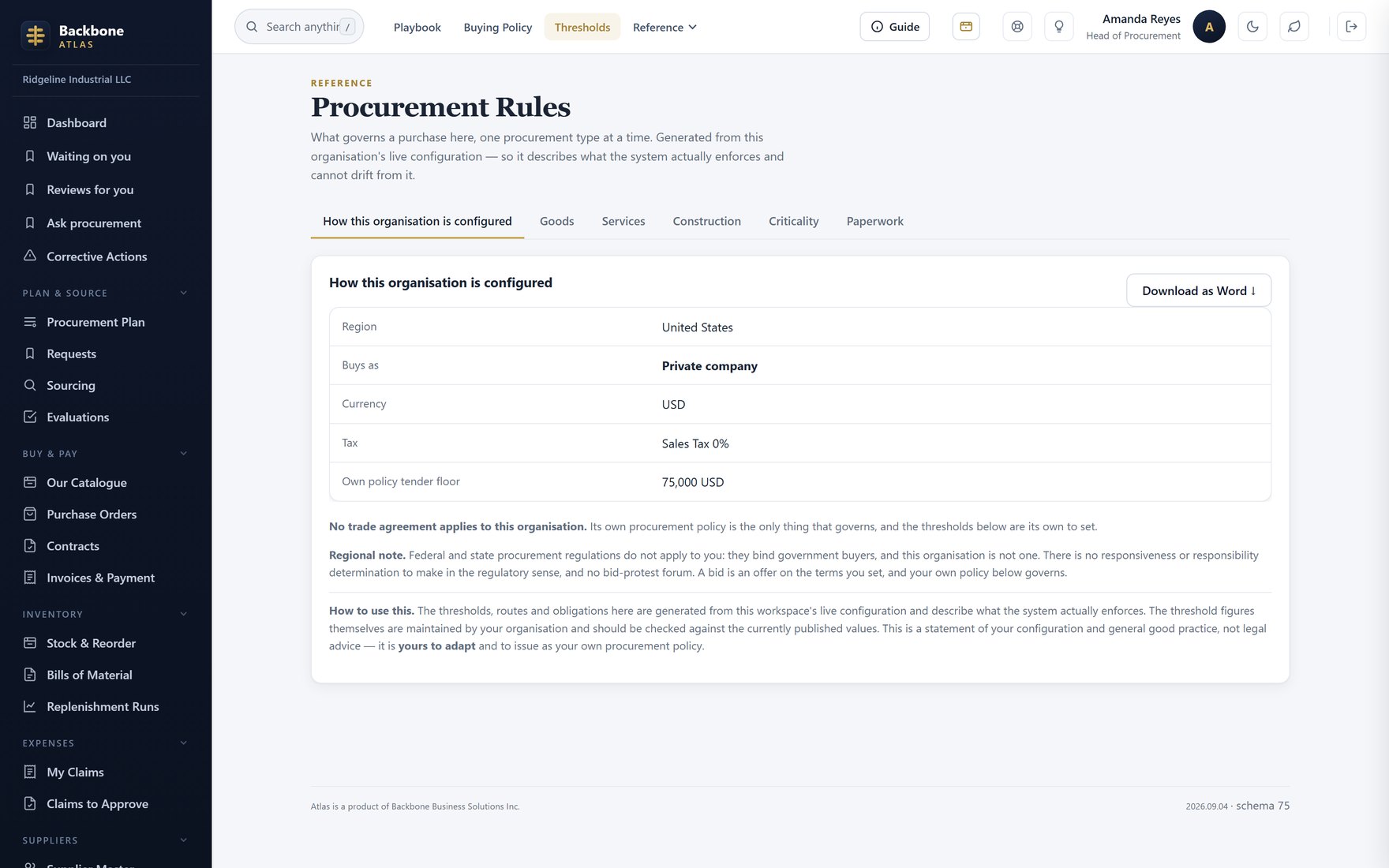
Not a currency symbol. The whole US rulebook.
This is the real settings screen. Choose the US and it sets dollars and sales tax.
That changes what lands in your books, not just what prints on a form.
Currency and tax set for the US from day one
No Contract A. A bid is an offer on your terms. Submitting it does not form a process contract.
Need another region? Switch it on this screen. Nothing else to set up.
.../settings
Region ProfileUSD · sales-tax handling · your own approval ladder.
Private sector Mid-market · Construction · Manufacturing · Distribution
Control spend. Manage suppliers.
For US companies that want the visibility and control a CFO expects.
Without a seven-figure suite or a year-long rollout.
See and cut spend that skips the process. Put more of it under contract.
Approvals and delegation that match your own sign-off limits
Value and how critical an item is both set the route. A $2,000 safety-critical part gets the process it needs, not the one its price suggests.
Contracts with renewal alerts. Blanket agreements for repeat buys.
Connects to eleven accounting systems. QuickBooks Online, Xero, Business Central and Sage Accounting are proven on live ledgers. NetSuite, Sage Intacct, Sage 300, Sage X3, SAP S/4HANA, Oracle Fusion and BILL are built. Each is proven on your own ledger at onboarding. Older ledgers pull a feed.
Live in days to weeks, not a year
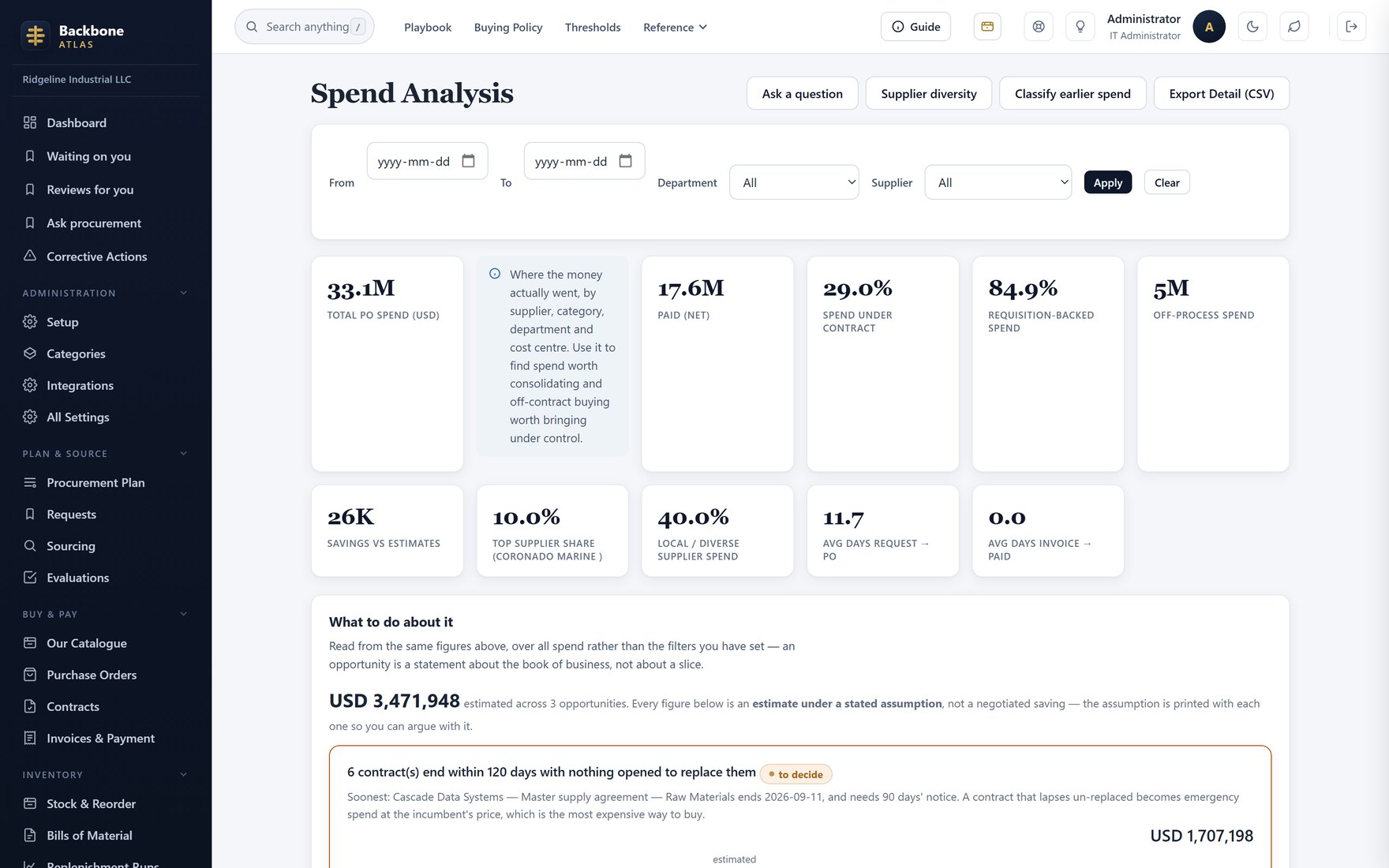
.../spend
Spend AnalysisUnder-contract, off-process and cycle times — in USD.
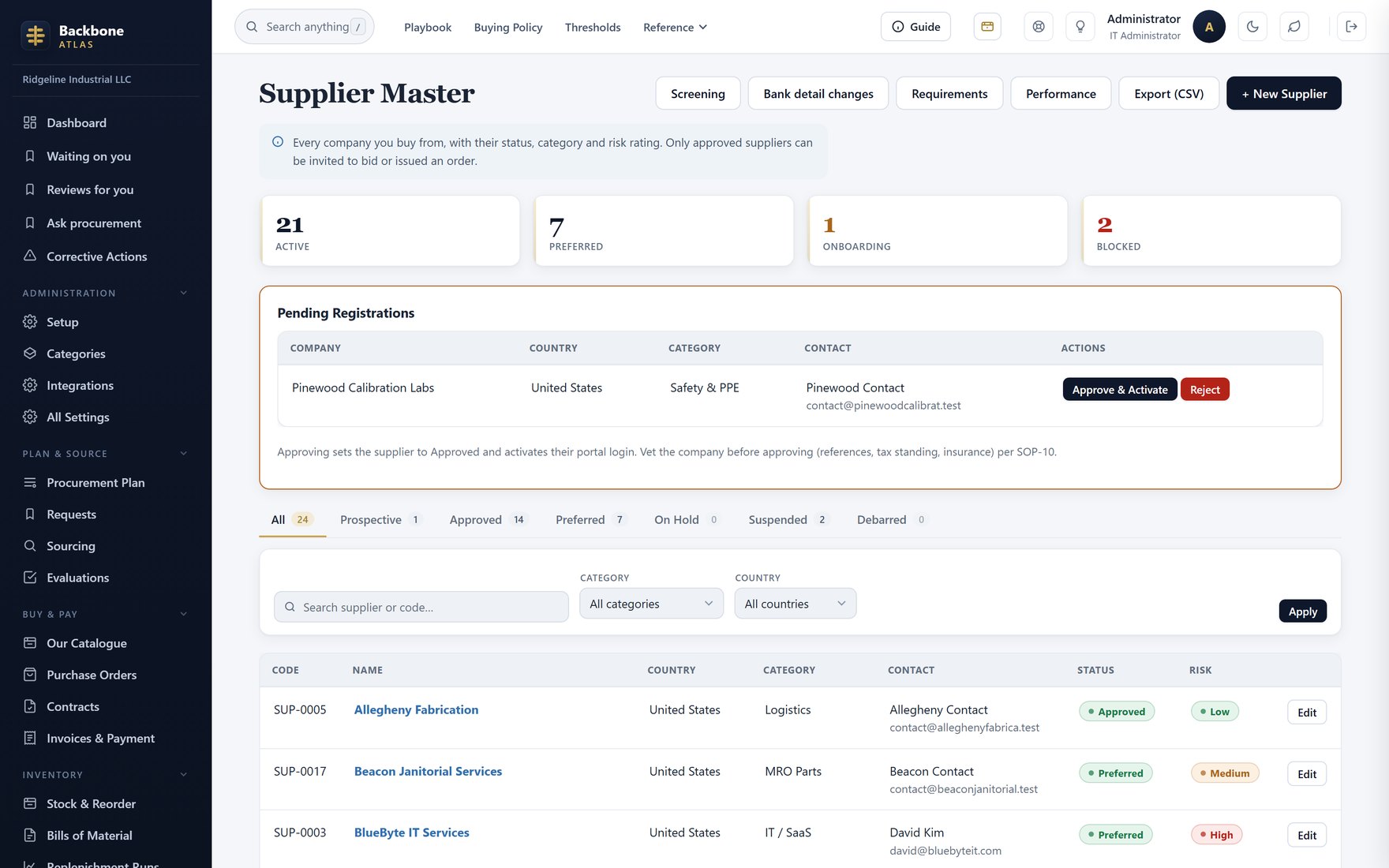
.../suppliers
Supplier MasterRisk, performance and lifecycle in one view.
Know who you're paying
Suppliers managed, not just listed.
One full record for each supplier: risk, performance and status. The details that get
abused are controlled. So a purchase never reaches the wrong vendor.
No awards to suspended, on-hold or debarred vendors
Bank-detail changes are locked down. It is the most abused field in procurement.
A supplier portal. Suppliers register, quote, get POs, send invoices and get paid. They keep their own documents and bank details up to date.
Certificates and documents chased automatically before they expire
Spend with diverse suppliers tracked for reporting
The whole event in one place
Run it properly, or run it quickly.
An RFQ for simple buys. An IFB when the specification decides. An RFP when
value matters more than price. An RFI first, to learn what the market can do.
Sealed responses stay hidden until a named person opens them
Scorers rate quality without seeing price. Price is scored automatically.
Price scored four ways: proportional, lowest compliant wins, line-by-line rates, or rates costed against expected volumes
Bidders see the scoring method in their documents. The evaluation uses that exact method.
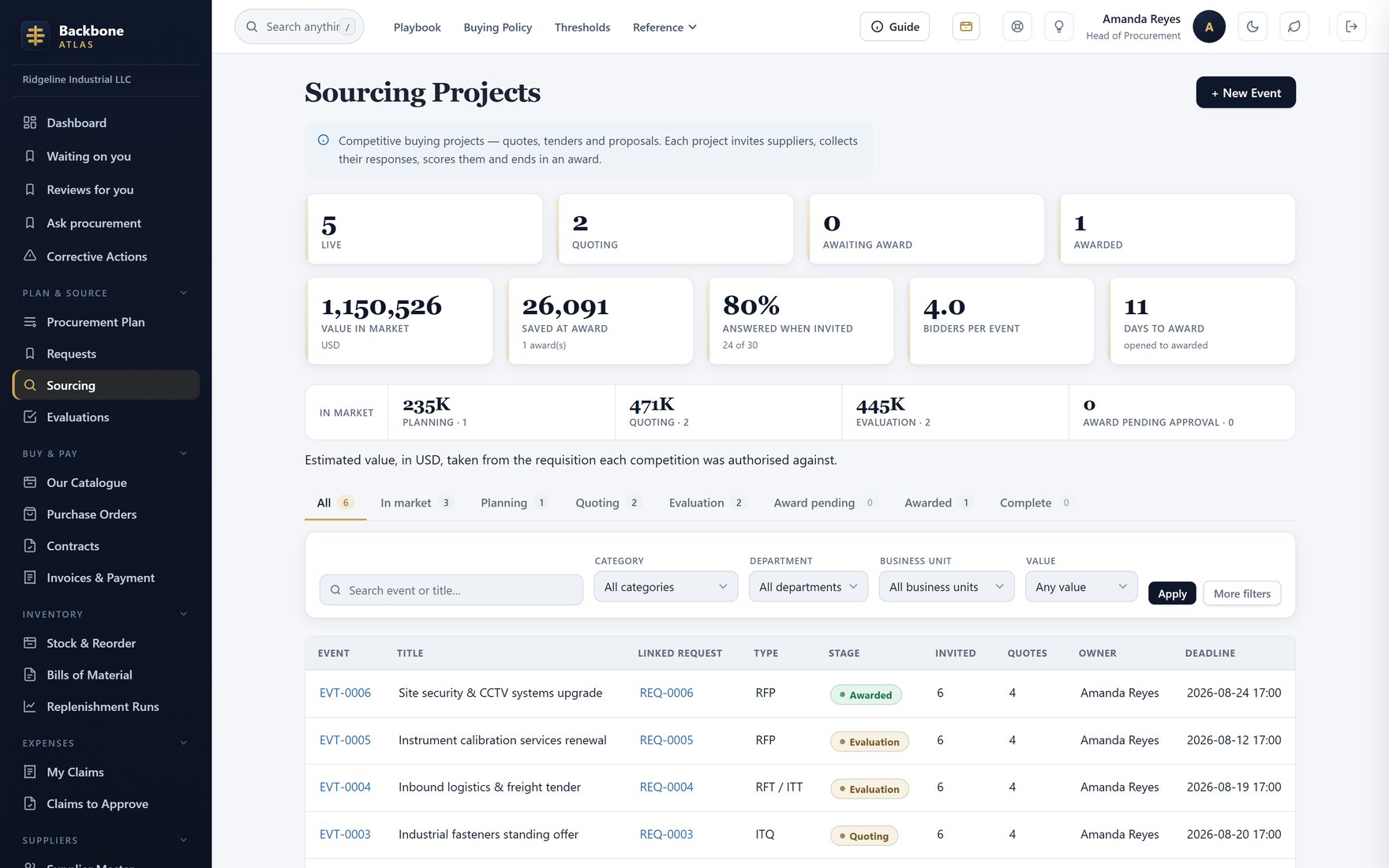
.../sourcing
Sourcing & EvaluationRFQ to sealed solicitation, with committee scoring.
Public sector
The public-sector process is built. Your rules are set up when you sign.
A US agency runs the same process as public buyers in Canada, the UK, the EU and the Gulf. Sealed bids, evaluation committees, award, standstill, contract and three-way match. What differs is your thresholds, rules and documents. We configure those for your jurisdiction before you go live.
A federal agency needs the FAR simplified-acquisition threshold and the WTO GPA figures. Everyone else needs their own state’s procurement code. A city, school district and state university do not buy under the FAR.
The federal thresholds are written. Your state’s code is added when you sign. A city, district or university gets its own state’s rules. It never sees a federal figure that does not bind it.
Some systems would show you a threshold table with nothing behind it. You would find out in an audit.
Until your rules are in, it refuses. No public solicitation until your thresholds and documents are configured. Atlas declines and says why.
A US public buyer? Tell us your jurisdiction. The process stays the same. We set up your thresholds and documents before you go live.
The gap it fills
Everything the current tools make you stitch together.
Procurement teams often juggle a sourcing tool, spreadsheets, email
and a finance system. Atlas puts it all in one place.
Sourcing-only tools stop at award. The contract, the spend and the three-way match are left to you.
Atlas goes all the way to payment. With three-way match and the journal your finance team needs.
Enterprise suites can do it all. For seven figures a year and a twelve-month rollout.
A fraction of the cost and time. Live in days to weeks.
Generic workflow tools miss sealed bidding, approval ladders and UNSPSC codes.
Built for procurement. Sealed bidding, the escalation ladder and UNSPSC codes are built in.
Most products cannot tell a company which country its data sits in.
A named country for your data. Hosted in Canada today. A dedicated United States instance is possible by separate agreement. The region is named in that agreement.
Policy documents drift. The Word file stops matching what the system does.
Generated, not hand-written. The rules page, role guides and walkthroughs come from the same settings the system enforces.
Some vendors claim regional coverage and hand you a relabelled generic product.
We say what isn’t built. US public is off, and this page says so. You won’t find out during your first solicitation.
Contracts & finance
Award to payment, with no handover.
The contract, its milestones and its value flow straight to your finance system.
No retyping. No manual handoff to AP.
E-signature, milestones, obligations and retention, all on record
Blanket agreements let buyers order at agreed prices without re-soliciting
Coded bills post to all eleven connected ledgers. Journals post to QuickBooks Online, Xero, Business Central, Sage, Sage Intacct and NetSuite. SAP S/4HANA and Oracle Fusion journals are built on request.
Renewal and expiry alerts before anything lapses
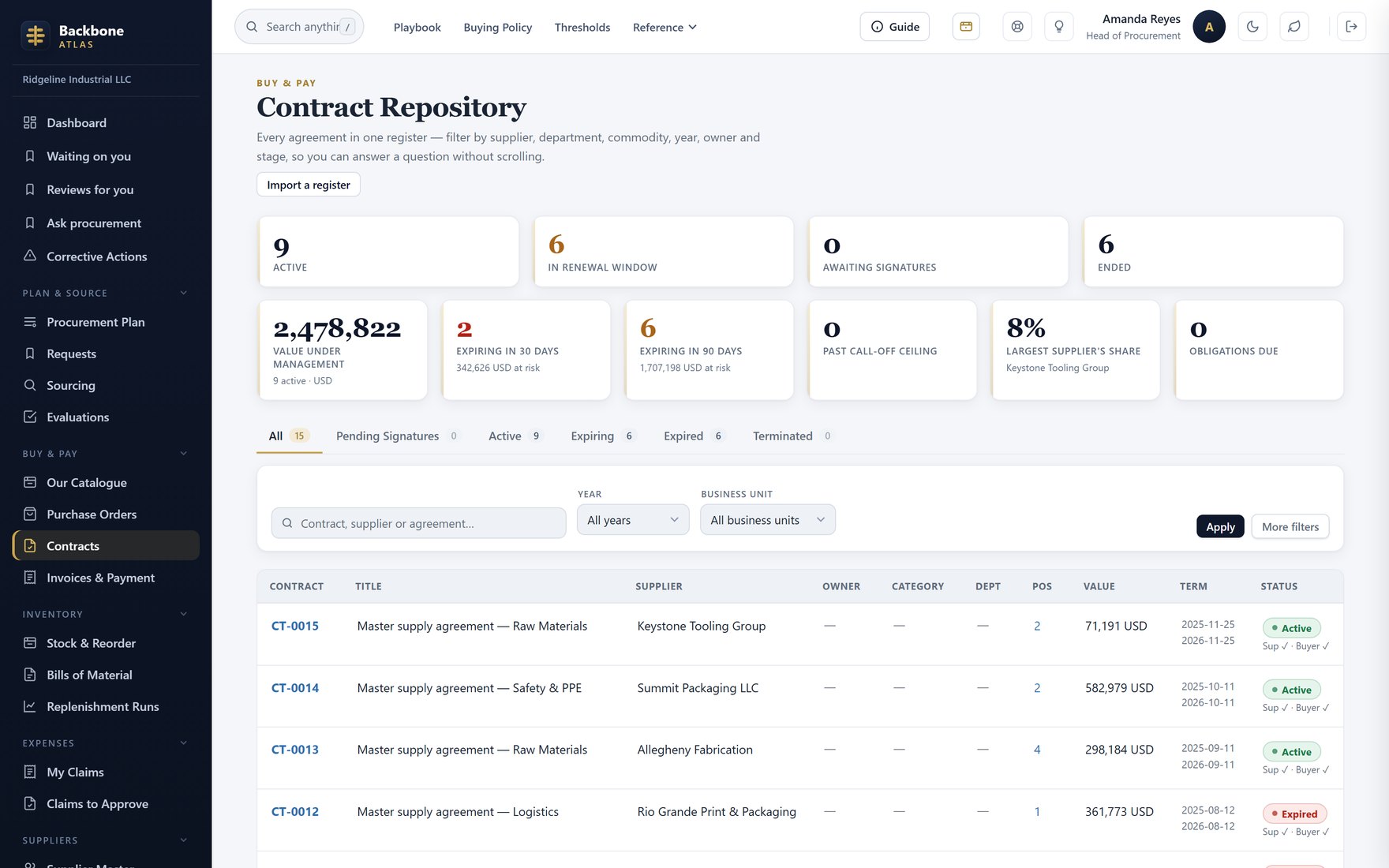
.../contracts
Contract ManagementLive, renewing, and never out of sight.
See it on your own procurement
Bring US procurement out of the inbox.
A short demo on your own categories, thresholds and approvals.
If it is not right for you, we will say so.