Procure-to-pay · United Kingdom
Built for the Procurement Act 2023.

The regime changed on 24 February 2025. Atlas runs the whole cycle to the new rules — open and competitive flexible procedures, assessment summaries, the eight-day standstill — through to PO, invoice and payment.

Procurement Act 2023 native Central & sub-central authorities Public & private sector A UK instance on request
.../rules
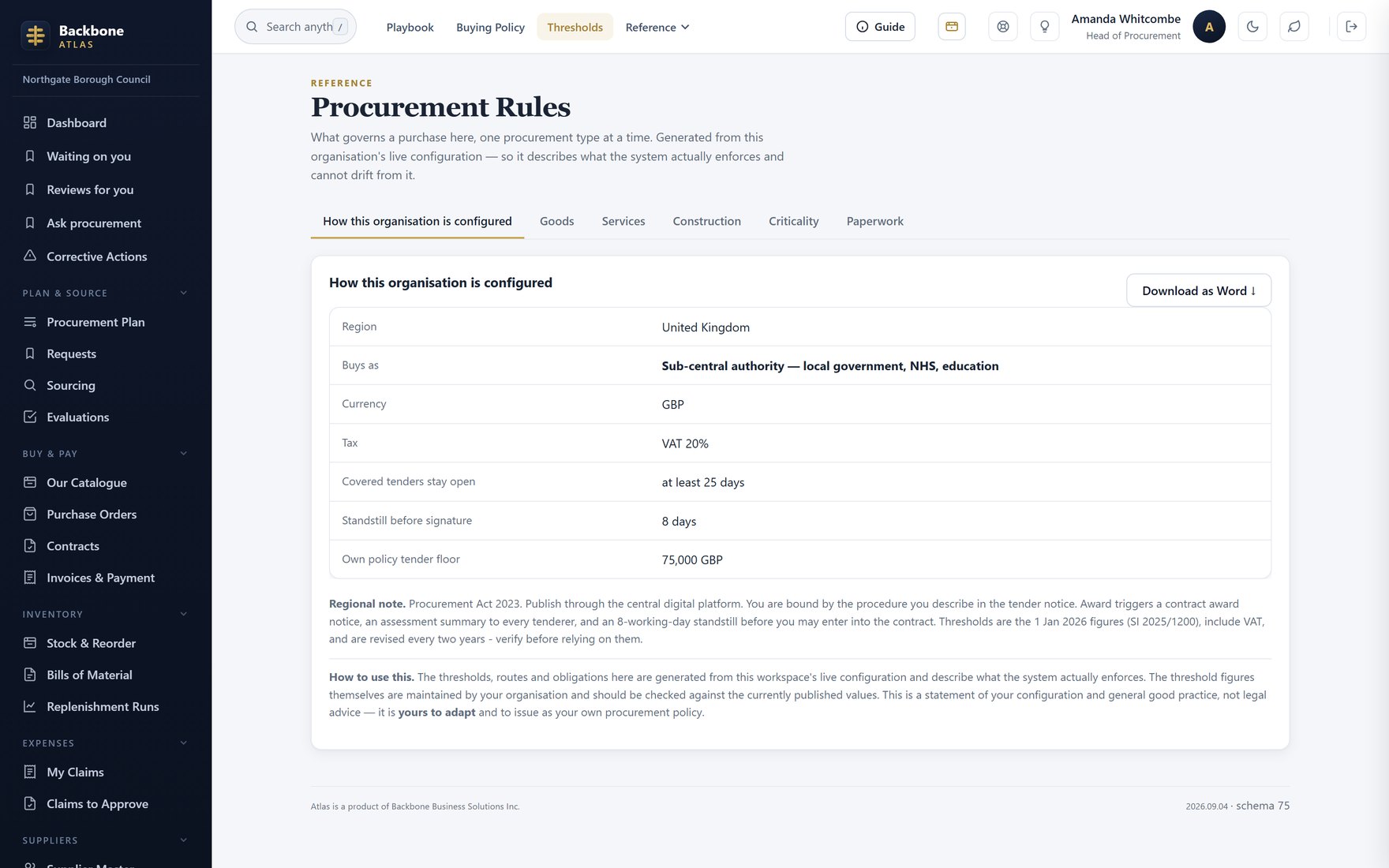
Procurement Rules generated for a UK contracting authority under the Procurement Act 2023
Not a claim — the live setting

Not a currency symbol. The whole UK rulebook.

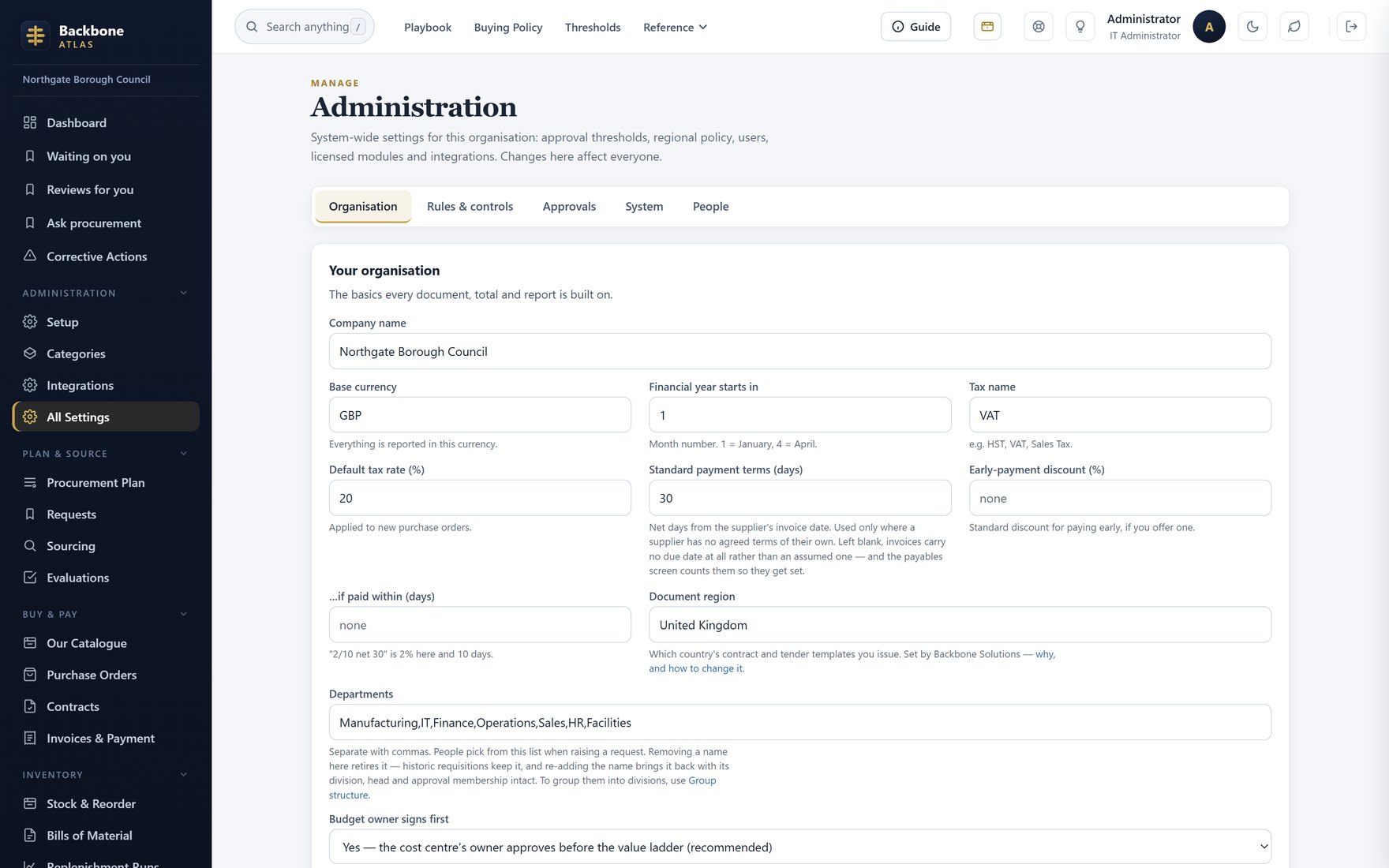
The actual settings screen, not marketing copy. The UK profile sets GBP, VAT and the Procurement Act 2023 threshold matrix — below-threshold duties, the light-touch regime, and the Act's own goods, services and construction bands.

  • Currency, tax and thresholds set to the UK the moment your instance goes live
  • Procurement Act 2023 thresholds loaded for goods, services and construction, government and MASH bodies
  • Switch regions from this same screen if you ever need to — nothing else to configure
.../settings
Region profile settings — United Kingdom
Region ProfileGBP · VAT 20% · Procurement Act 2023 thresholds.
Public sector Central gov · Local · NHS · Education

The new regime, run correctly.

For contracting authorities under the Procurement Act 2023 — central government, local authorities, NHS bodies, schools and universities — where the procedure you publish is the procedure you are held to.

  • The three award routes — open procedure, competitive flexible procedure, and direct award on a Schedule 5 ground
  • Conditions of participation, down-selection and negotiation — designed and recorded as you publish them
  • Assessment summaries and the 8-working-day standstill handled by the workflow, not a checklist
  • Thresholds built in — £135,018 central, £207,720 sub-central, £5,193,000 works (from 1 Jan 2026, VAT-inclusive)
  • Exclusion grounds, KPI publication and contract-change notices reflected throughout
  • Hosted in Canada today; where policy requires procurement data to stay in the country, a dedicated UK instance is stood up when you sign
.../rules
Procurement Rules, generated from this organisation's live configuration
Methodology PlaybookEvery Act route, with its statutory basis.
.../sourcing
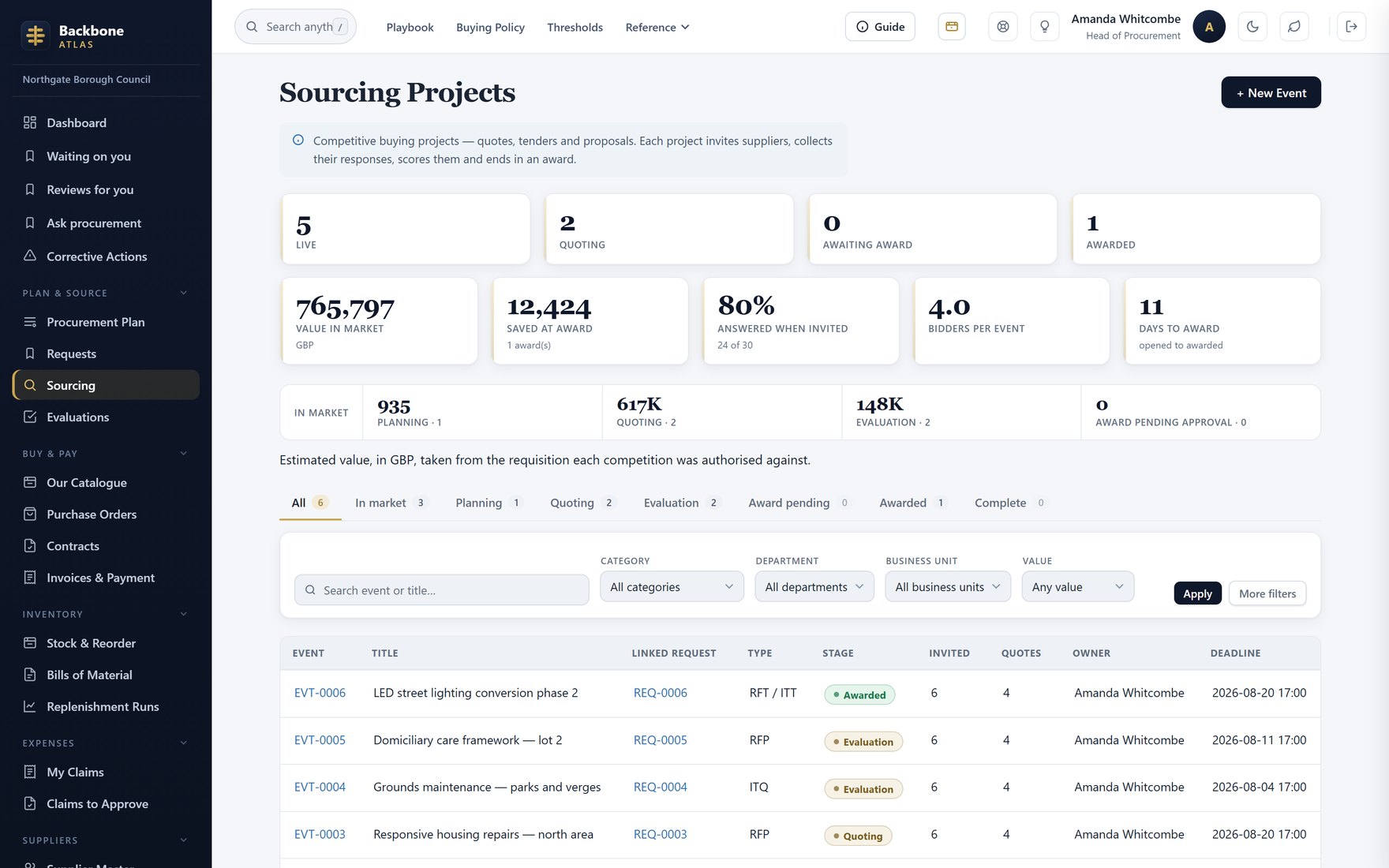
Sourcing pipeline
Sourcing & EvaluationOpen or competitive flexible, with committee scoring.
Bound by what you publish

Design the procedure, then run exactly that.

The competitive flexible procedure gives you freedom — and holds you to it. Backbone keeps the procedure you published and the record that proves you followed it.

  • Sealed bids opened by a named person; committees score blind to price
  • Minimum requirements and award criteria fixed, then enforced
  • Every clarification, stage and score kept for the assessment summary and any challenge
  • Contract award notices and transparency records produced from the same data
Private sector Mid-market · Construction · Manufacturing

Spend under control, suppliers under management.

For UK companies that want procurement discipline — the visibility a finance director expects — without a six-figure suite or a year-long rollout.

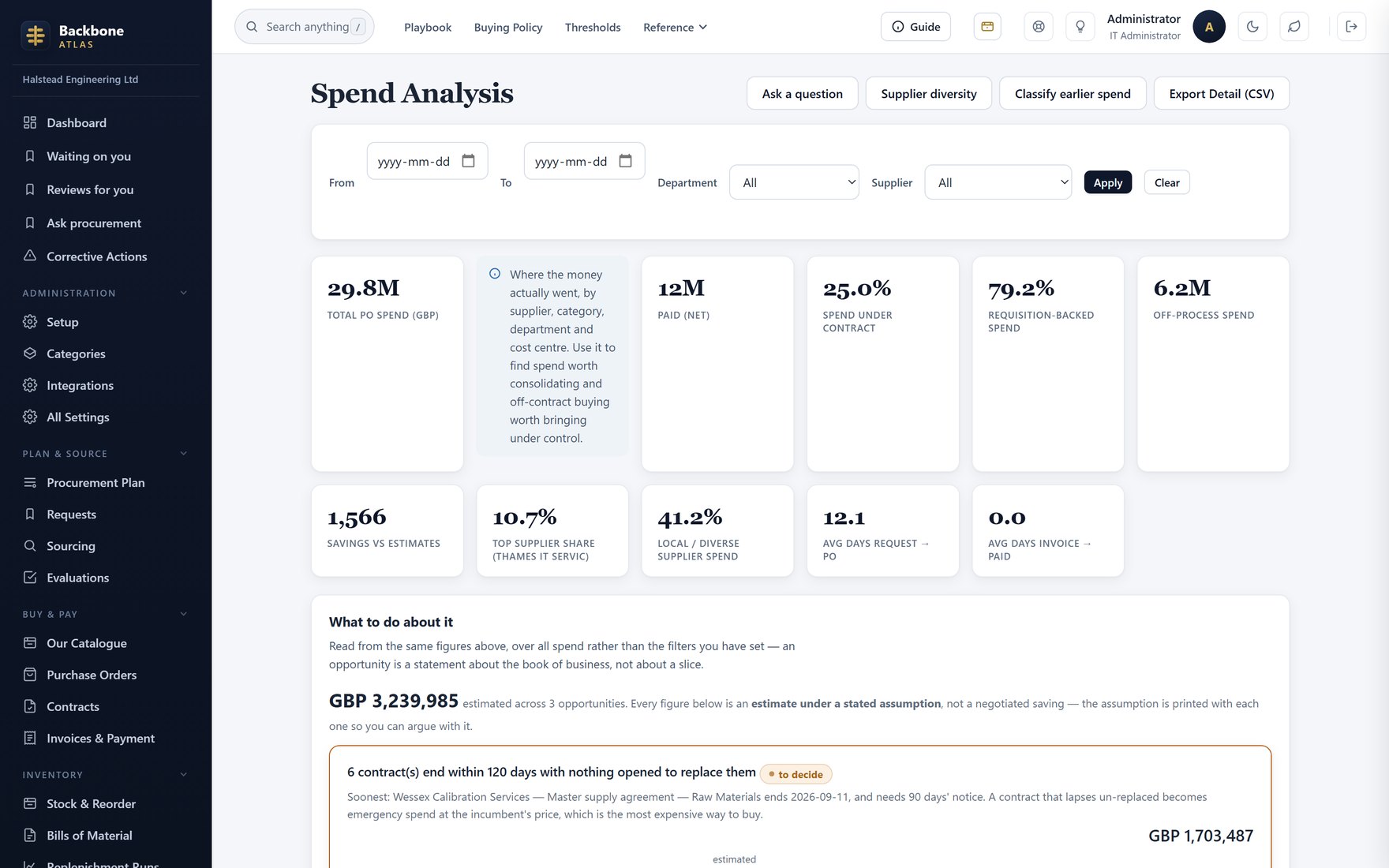
  • See and cut off-process spend — drive more of it under contract, in sterling, on real numbers
  • Approvals and delegation matched to your own authority matrix
  • Supplier 360 with risk, performance and hard gates that block the wrong vendor
  • Contract lifecycle with renewal alerts; framework call-offs for repeat buys
  • Connects to your accounting system — eleven systems — QuickBooks Online, Xero, Business Central and Sage Accounting proven against live ledgers; NetSuite, Sage Intacct, Sage 300, Sage X3, SAP S/4HANA, Oracle Fusion and BILL built, each proven on your own ledger at onboarding; older ledgers pull a feed
  • Live in days to weeks, not the year a suite takes to stand up
.../spend
Spend analysis in GBP
Spend AnalysisUnder-contract, off-process and cycle times — in £.
.../suppliers
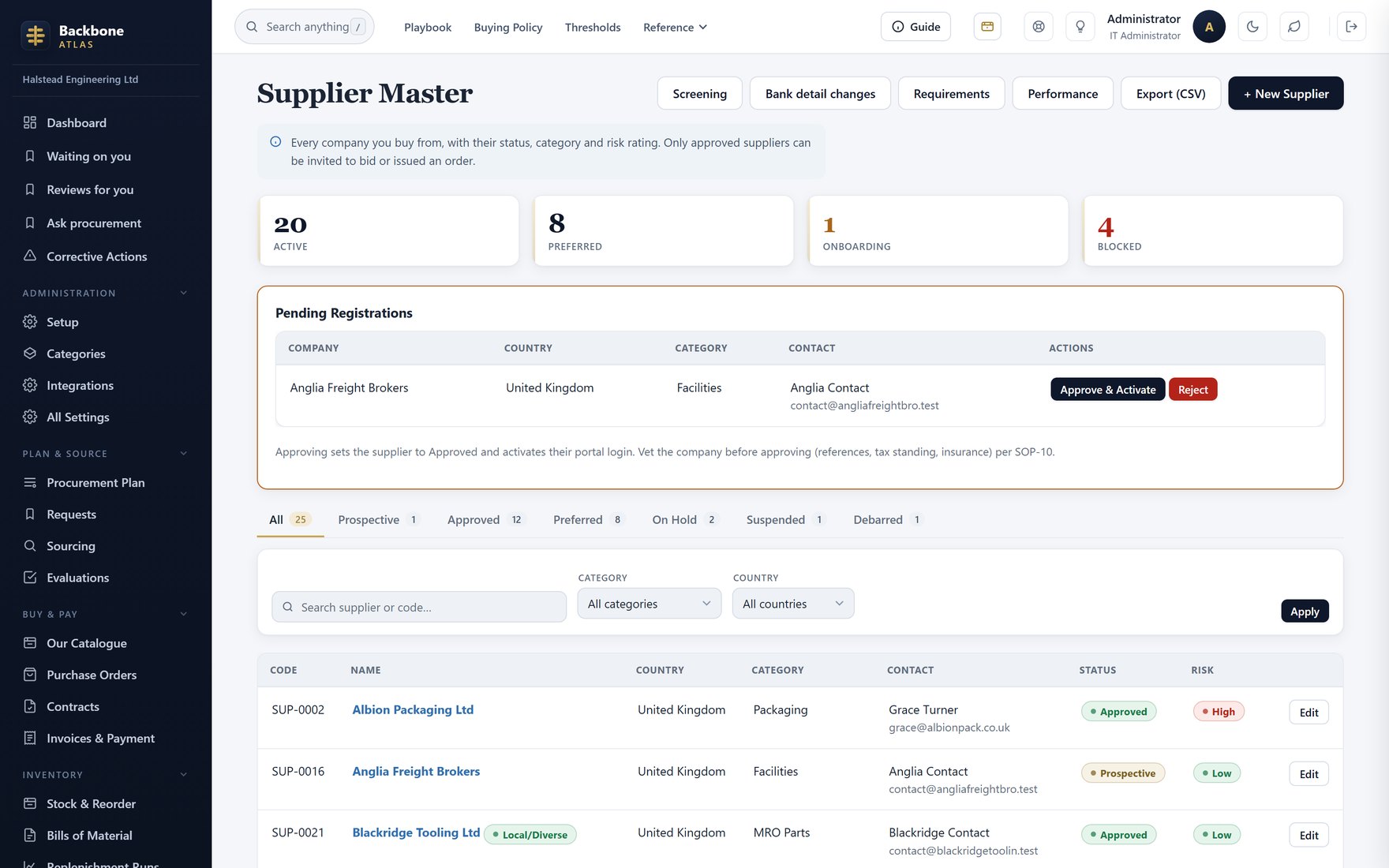
Supplier master
Supplier MasterRisk, performance and lifecycle in one view.
Know who you're paying

Suppliers managed, not just listed.

A full supplier record with risk and performance, lifecycle gates, and control over the details that get abused — so a purchase never reaches a supplier it shouldn't.

  • Lifecycle status blocks awards to suspended, on-hold or debarred suppliers
  • Controlled bank-detail changes — the most abused field in procurement, locked down
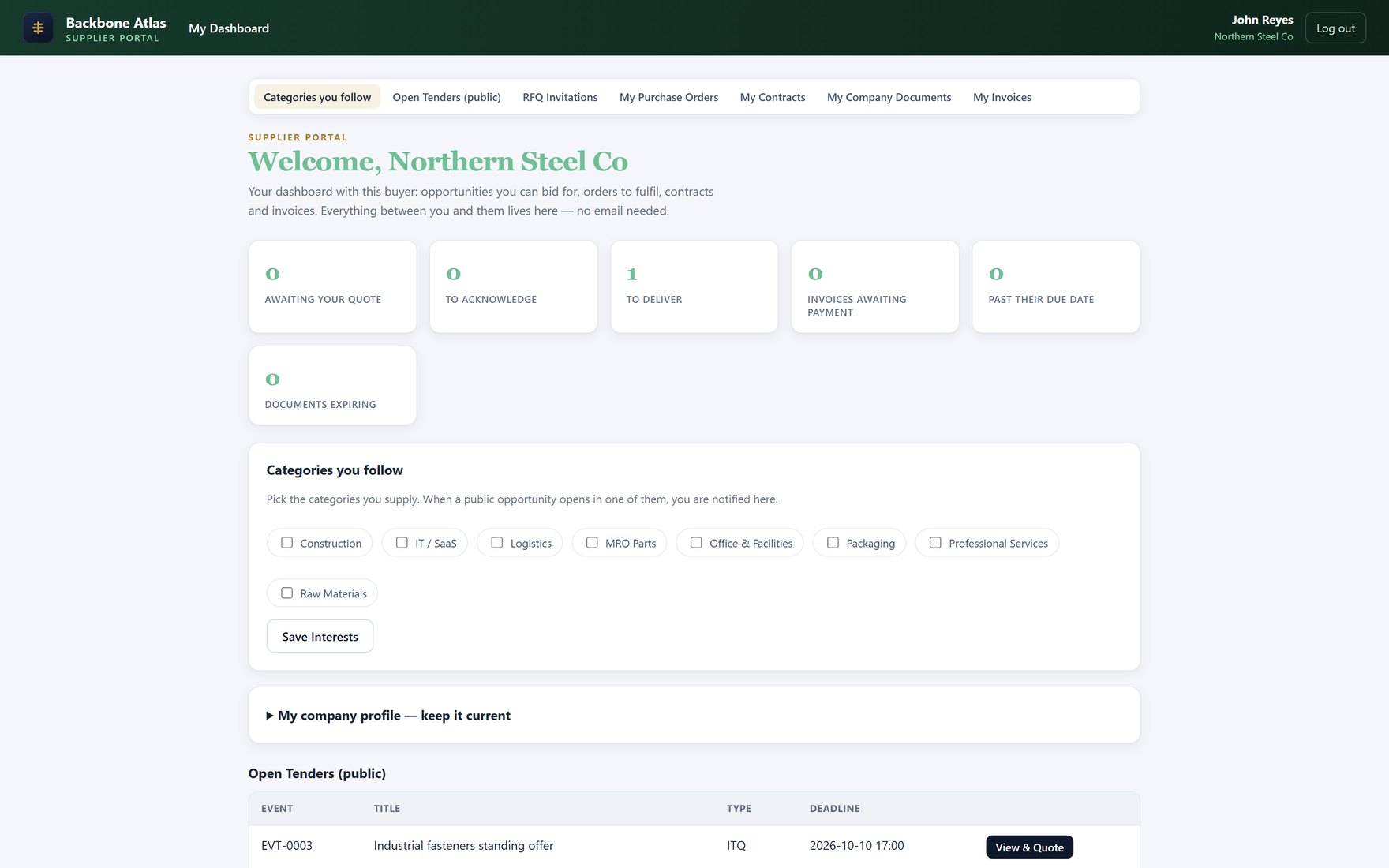
  • A supplier portal where they register, quote, receive POs, submit invoices and get paid — and keep their own documents and bank details current
  • Exclusion-ground declarations and expiring documents tracked automatically
  • Social-value and local-supplier spend tracked, for the reporting that matters
The gap it fills

Most tools are still built for the old rules.

The Procurement Act 2023 changed the procedures, the notices and the standstill. Much of what's on the market was built for the regime it replaced — and still leaves you to stitch the cycle together.

Tools built for the old regime still talk in restricted procedures and OJEU notices the Act has replaced.
Act-native. The open and competitive flexible procedures, assessment summaries, transparency notices and the 8-day standstill — as the Act now defines them.
Find a Tender and eSourcing portals publish the notice — then leave evaluation, contracts, POs and invoices to spreadsheets.
Runs the whole cycle — procedure, evaluation, award, contract, PO, receipt, invoice and payment, in one auditable flow.
Most tools serve the public sector or the private sector — never both.
One system serves both. Turn the Act's procedures on for an authority, or run it lean for a company.
Enterprise suites can do it all — for six figures a year and a twelve-month implementation.
A fraction of the cost and time. Configured and live in days to weeks, with your UK instance stood up when you sign.
The 30-day payment terms the Act flows down the supply chain are an afterthought in generic tools.
Built into the contract and PO terms, so the statutory payment obligations are there from the start.
Most products host where they host — and cannot tell a public body which country its procurement data sits in.
A UK instance, on request. Hosted in Canada today; a dedicated UK instance is stood up when you sign, with the country named in the agreement.
Connects to your stack

Sits alongside the systems you already run.

Atlas stays the procurement record and posts straight to your connected ledger; an older ledger pulls a read-only feed on its own schedule — so contracts and their milestones reach AP without a manual handover.

  • Coded bills post to all eleven connected ledgers; purchase orders to eight, journals to six
  • Older ledgers pull read-only purchase order, invoice, supplier, contract and journal feeds, as JSON or CSV
  • The feeds work with SAP, Oracle, Sage or your own system — no middleware
  • Single sign-on with your existing Microsoft, Google or Okta accounts
  • One API key, secured; integration is off until you switch it on
.../integrations
Integration Hub — ledger connections and feeds
Integration HubPosts to your ledger, or feeds an older one.
See it on your own procurement

Procurement, to the new rules.

A short demo on your categories, your thresholds and your sector — public or private — with the full cycle, end to end, run to the Procurement Act 2023.

Book a demo

The Procurement Act 2023 applies to England, Wales and Northern Ireland; Scotland runs its own regime, which Atlas does not carry yet; it is configured on request.