Procure-to-pay · European Union
Directive 2014/24 — in any member state.

The open, restricted and competitive procedures with negotiation, the ESPD, the standstill — run correctly, configured for the national law that applies. One system, from requisition to payment, in your currency and VAT rate.

Directive 2014/24 procedures Any member state & currency Public & private sector An EU instance on request
.../rules
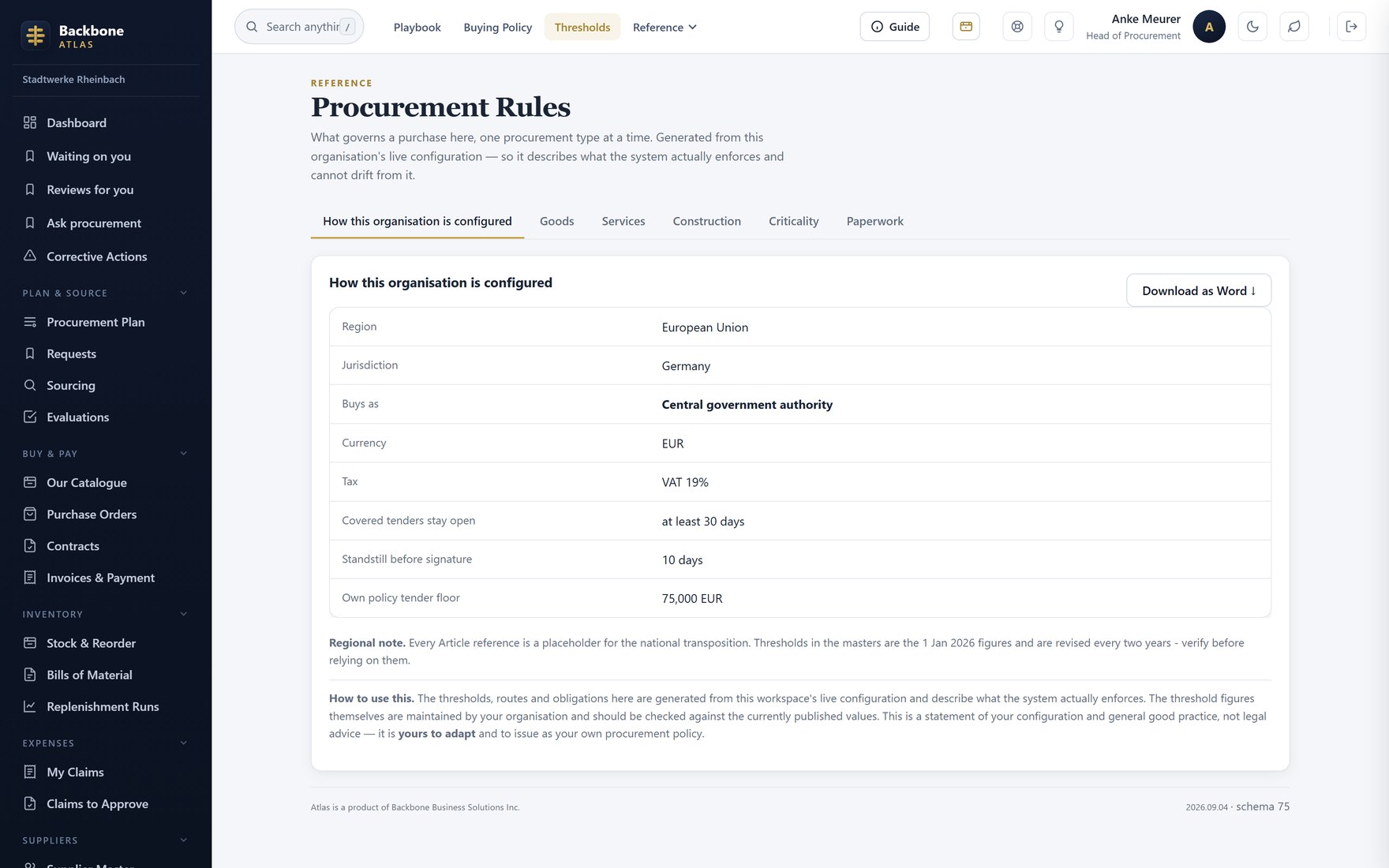
Procurement Rules generated for an EU contracting authority under Directive 2014/24
Not a claim — the live setting

Not a currency symbol. The whole Directive.

The actual settings screen, not marketing copy. The EU profile sets your member state's currency and standard VAT rate — all 27 preloaded — and the Directive 2014/24 threshold matrix as your starting point, ready to align to your member state's national transposition.

  • Currency, tax and thresholds set to the EU the moment your instance goes live
  • Directive 2014/24 thresholds loaded as your configurable starting point
  • Switch regions from this same screen if you ever need to — nothing else to configure
.../settings
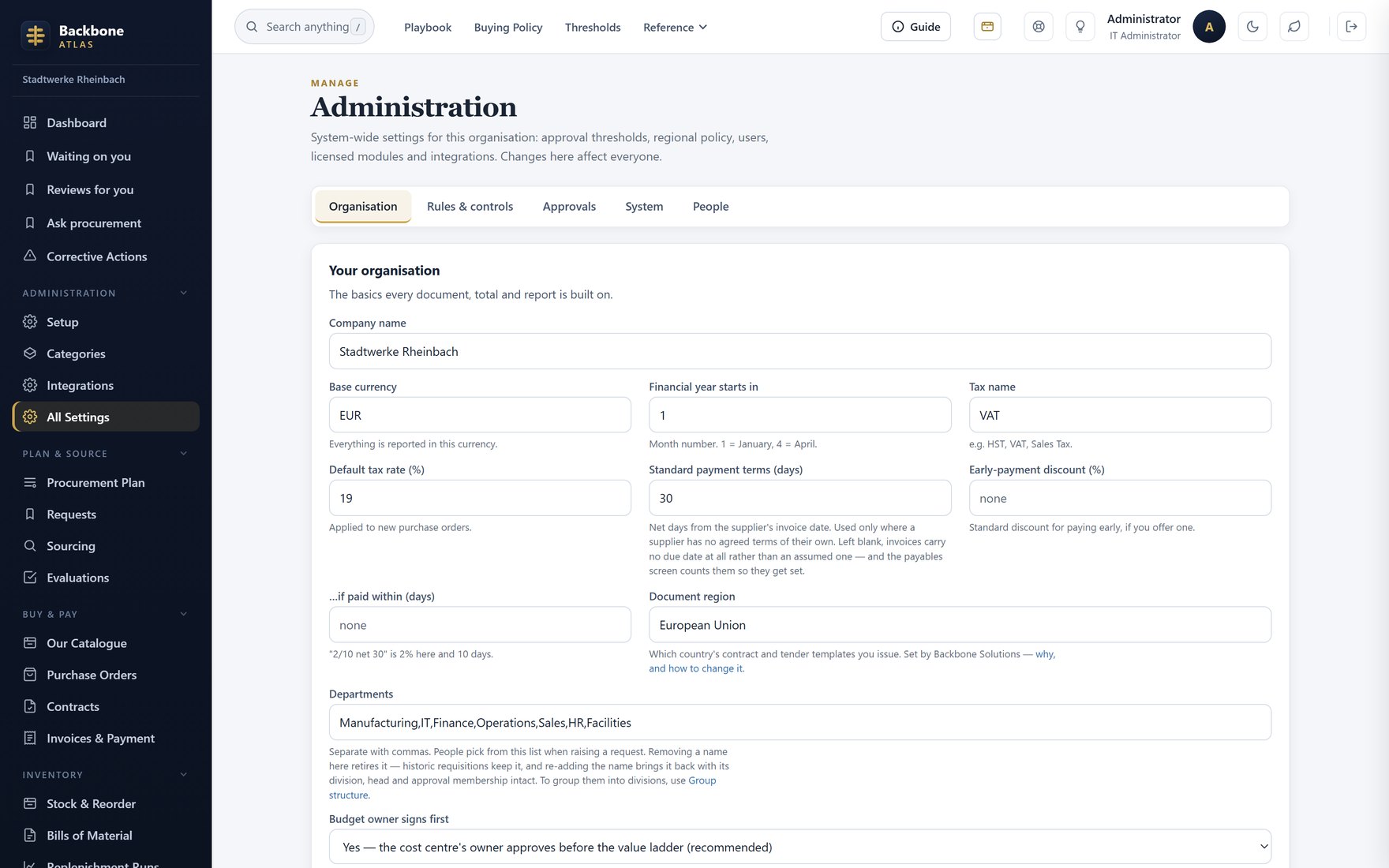
Region profile settings — European Union
Region ProfileMember-state currency · standard VAT rate · Directive 2014/24 thresholds.
Public sector Central · Sub-central · Bodies governed by public law

The Directive's procedures, run to the letter.

For contracting authorities across the Union — where the Directive sets the procedures but every member state transposes them into its own national law.

  • Open, restricted and competitive-with-negotiation procedures, plus works contract tenders
  • The ESPD and self-declaration of exclusion and selection criteria built into the response forms
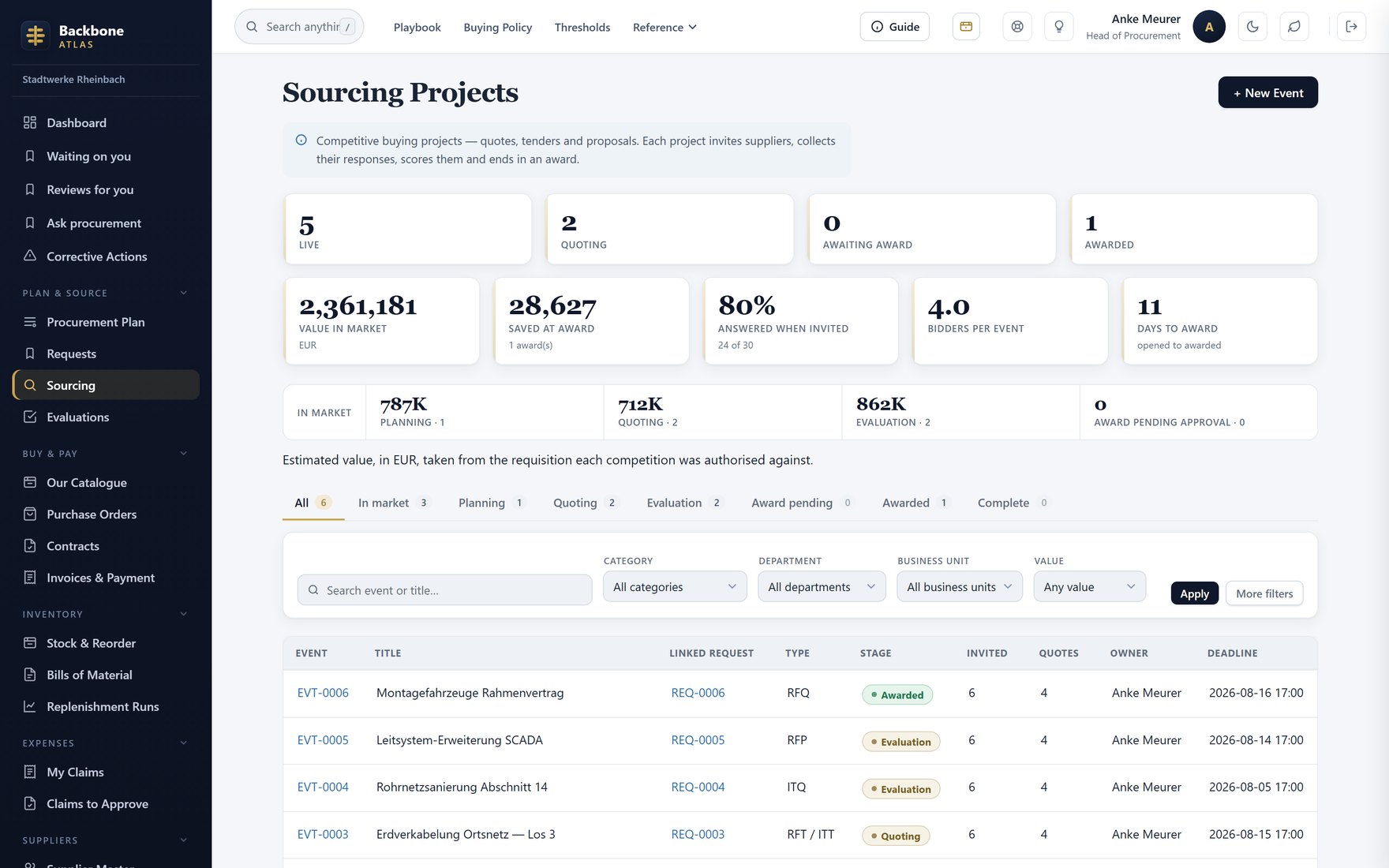
  • MEAT evaluation — committees score quality blind to price; the standstill enforced before award
  • Thresholds built in — €140,000 central, €216,000 sub-central, €5,404,000 works (from 1 Jan 2026)
  • Configured for your national transposition — the Article references map to your country's statute
  • Hosted in Canada today; a dedicated EU instance is stood up when you sign — built to support your GDPR obligations either way
.../sourcing
Sourcing pipeline — EU procedures
Sourcing & EvaluationOpen or restricted, with ESPD and standstill.
Private sector Mid-market · Industrial · Multi-country groups

Spend control across borders and currencies.

For European companies and groups that buy across several countries — procurement discipline that works whatever the currency or VAT rate.

  • Set to your member state — its currency and standard VAT rate, all 27 preloaded, with other currencies converted at FX rates
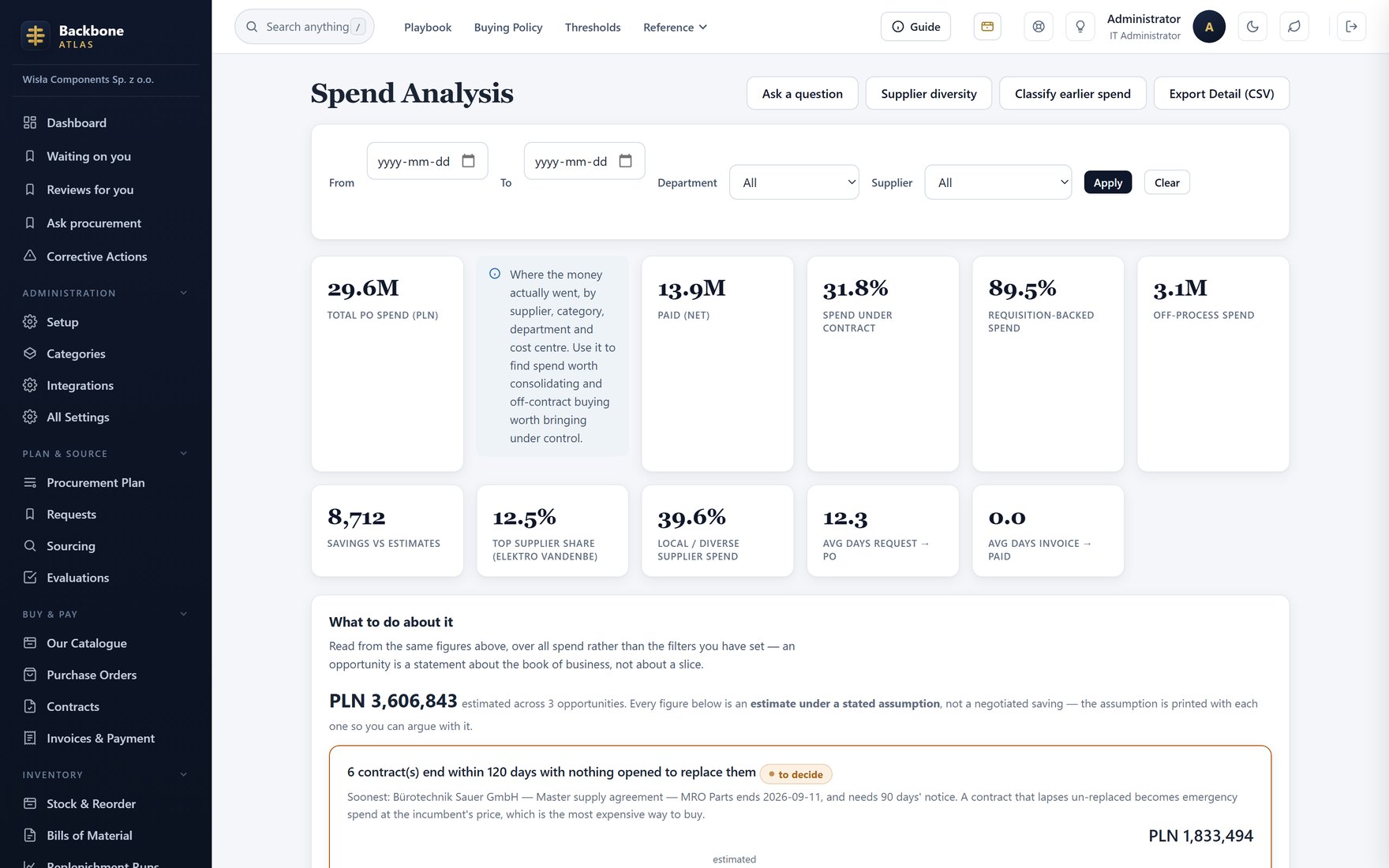
  • See and cut off-process spend; drive more of it under contract, on real numbers
  • Supplier 360 with ESG and Scope-3 tracking for CSRD-era reporting
  • Contract lifecycle with renewal alerts; framework call-offs for repeat buys
  • Connects to your accounting system — eleven systems — QuickBooks Online, Xero, Business Central and Sage Accounting proven against live ledgers; NetSuite, Sage Intacct, Sage 300, Sage X3, SAP S/4HANA, Oracle Fusion and BILL built, each proven on your own ledger at onboarding; older ledgers pull a feed
  • Peppol-ready — reads UBL/Peppol and Factur-X e-invoices with their arithmetic checked, and produces Peppol purchase orders; delivery runs through an accredited access point, contracted before first use
  • Live in days to weeks, not the year an enterprise suite takes
.../spend
Spend analysis in EUR
Spend AnalysisUnder-contract, off-process and cycle times — in €.
.../suppliers
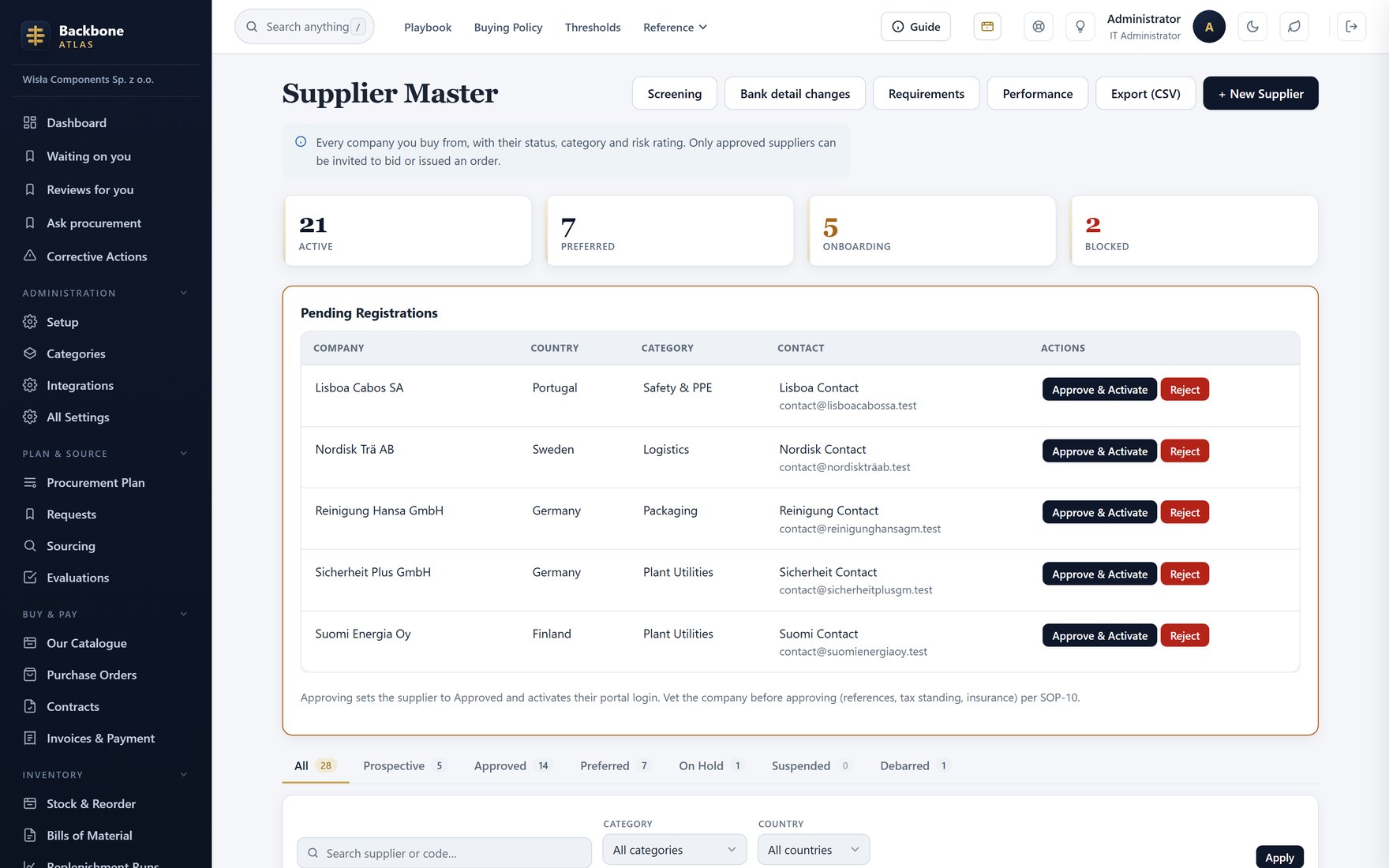
Supplier master
Supplier MasterRisk, performance and ESG in one view.
Know who you're paying

Suppliers managed, not just listed.

A full supplier record with risk, performance and the exclusion and ESG signals the Directive and CSRD increasingly require.

  • Lifecycle gates block awards to suspended, on-hold or debarred suppliers
  • ESPD and exclusion-ground declarations captured against each supplier
  • Controlled bank-detail changes — the most abused field in procurement, locked down
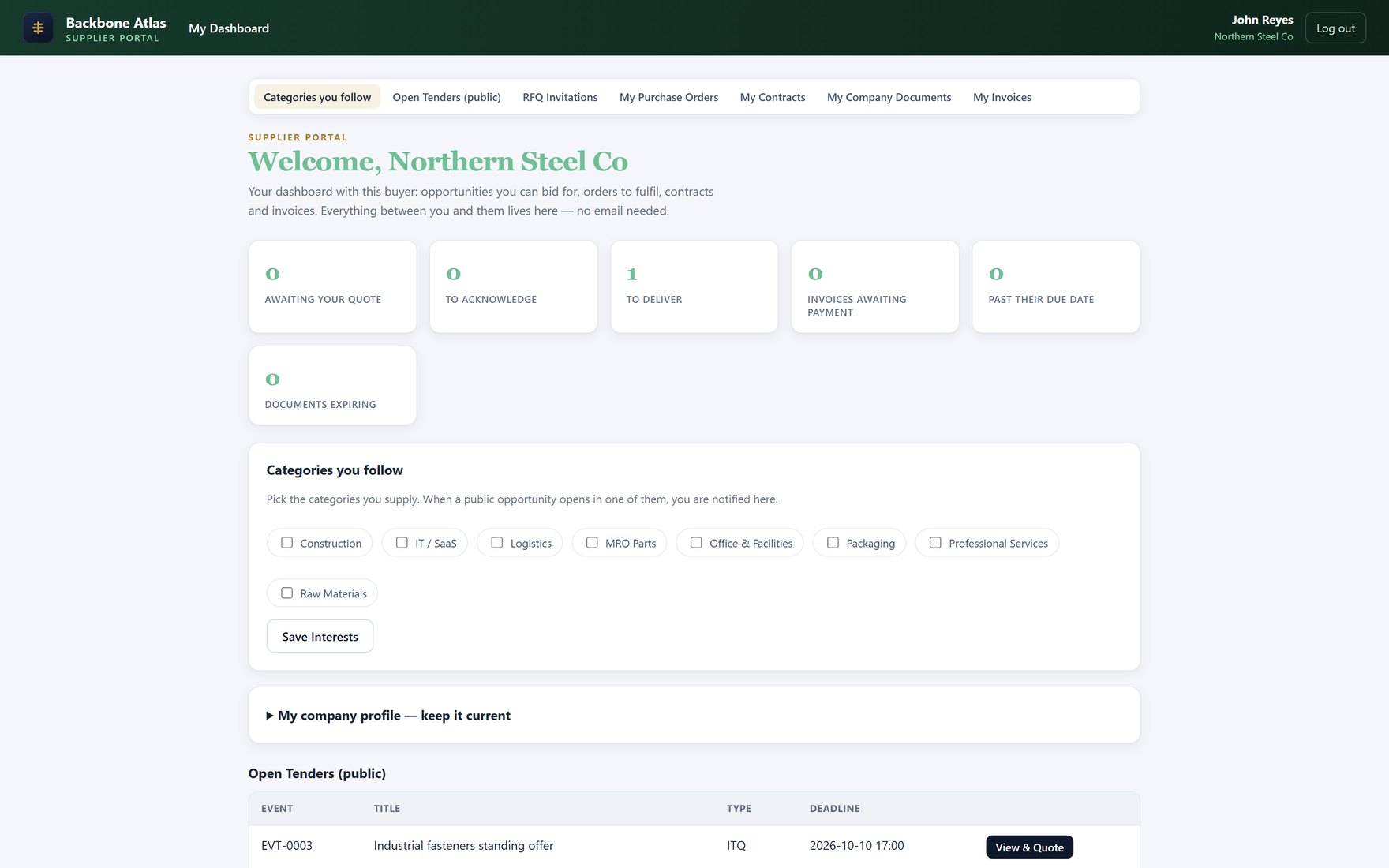
  • A supplier portal where they register, quote, receive POs, submit invoices and get paid — and keep their own documents and bank details current
  • ESG, Scope-3 and diverse-supplier spend tracked for sustainability reporting
The gap it fills

One directive, twenty-seven ways to apply it.

The Directive is common; the national transposition, the currency and the VAT are not. Most tools pick one country or leave the whole cycle for you to assemble.

Generic tools treat "EU procurement" as one thing, ignoring that every member state transposes the Directive into its own law.
Configured per member state — the procedures are the Directive's; the Article references map to your national statute.
Single-country tools assume one currency and one VAT rate — a problem the moment you buy across borders.
Your member state's currency and VAT rate — all 27 preloaded, with other currencies converted at FX rates.
TED and national portals publish the notice — then leave evaluation, contracts, POs and invoices to spreadsheets.
Runs the whole cycle — procedure, ESPD, evaluation, award, contract, PO, invoice and payment, in one flow.
Most tools serve the public sector or the private sector — never both.
One system serves both. Turn the Directive's procedures on for an authority, or run it lean for a company.
Enterprise suites can do it all — for six figures a year and a twelve-month implementation.
A fraction of the cost and time. Configured and live in days to weeks, with your EU instance stood up when you sign.
Data-protection and residency questions get answered late, and awkwardly, by a product hosted in one place.
An EU instance, on request. Hosted in Canada today; a dedicated EU instance is stood up when you sign. Built to support your GDPR obligations either way.
Connects to your stack

Sits alongside the systems you already run.

Atlas stays the procurement record and posts straight to your connected ledger; an older ledger pulls a read-only feed on its own schedule — so contracts and their milestones reach AP without a manual handover.

  • Coded bills post to all eleven connected ledgers; purchase orders to eight, journals to six
  • Older ledgers pull read-only purchase order, invoice, supplier, contract and journal feeds, as JSON or CSV
  • The feeds work with SAP, Oracle, Dynamics or your own system — no middleware
  • Single sign-on with your existing Microsoft, Google or Okta accounts
  • One API key, secured; integration is off until you switch it on
.../integrations
Integration Hub — ledger connections and feeds
Integration HubPosts to your ledger, or feeds an older one.
See it on your own procurement

European procurement, in one system.

A short demo on your country, your categories and your sector — with the full cycle, end to end, configured for the law that applies to you.

Book a demo

The document templates carry Directive Article references as placeholders for your national transposition; your legal team confirms them before use.